Rulings in Flynn and McGahn Cases: What Might Be Next?

On the last day of August, the D.C. Circuit handed down decisions in two cases of great public interest. The first was the effort by retired General Michael Flynn to prevent District Judge Emmet Sullivan from holding a hearing on the Department of Justice’s motion to allow Flynn to withdraw his guilty plea and dismiss all the charges against him. The second was in the lawsuit by the Judiciary Committee of the House of Representatives to obtain the testimony of former White House Counsel Donald McGahn as part of its impeachment investigation of the President. Although these were both significant rulings, they – like so many of those in politically charged cases – are almost certain not to be the last word. I have dusted off my well-used crystal ball and am prepared to reveal what it said.

This was the second ruling by the D.C. Circuit in the Flynn case this summer. In the first, a divided panel enjoined Judge Sullivan from even holding a hearing on the Government’s motion, on the theory that there was no lawful basis for denying it. The full court then heard the case, and this time Flynn lost by a vote of 8-2, with the majority concluding that his plea was premature and that, until Judge Sullivan ruled against him, the court of appeals would not intervene.

Flynn now has two choices. He can ask the Supreme Court to overturn this decision, or he can proceed with the Government’s pending motion before Judge Sullivan. There are risks and rewards to him and the Government under both options. On the first, the Supreme Court will almost certainly not act on such a request in a hurry, even if a majority agreed that Sullivan should simply have granted the DOJ’s motion, as the dissenters in the circuit court concluded. This is, after all, an election year, and jumping in when there has not even been a hearing, let alone a ruling from the district court, would be seen as validating the claim that the willingness of the DOJ to allow Flynn to withdraw his guilty plea was based entirely on the wishes of the President for whom Flynn worked briefly.

Moreover, if Flynn does seek High Court review, Judge Sullivan would almost certainly not hold the hearing until the Court acted, which might be some time. And if the Court granted review, that would probably mean the case would not be argued until after January 20, 2021, when the President might be Joseph Biden and not Donald Trump. In that case, a new Attorney General might reverse positions once again, and rescind the motion to set aside Flynn’s guilty plea, thereby mooting the case and permitting Judge Sullivan to sentence Flynn. On the other hand, if Flynn does not seek immediate Supreme Court review, Judge Sullivan is likely to hold a hearing in the near future and rule well before next January. And, of course, if things go badly for Flynn, the President could pardon him, as he did for Roger Stone. For all those reasons, my bet is on Flynn taking his chances before Judge Sullivan, but then I would not have predicted he would have tried or even been initially successful in the D.C. Circuit.

The McGahn case presents a narrower set of likely choices, but there are considerable uncertainties about what happens after it obtains a favorable circuit court ruling. The case is a subpoena enforcement action made necessary when the President instructed his former counsel not to provide the testimony that the Judiciary Committee sought. The district court enforced the subpoena, but a divided panel concluded that the House had no standing to sue to enforce its subpoena against a high-ranking member of the President’s staff. Like the initial Flynn decision, that did not last long, as the court granted en banc review and reversed the decision, creating a major precedent that the House and Senate have standing to enforce subpoenas issued to executive branch officials.

There were, however, two other grounds on which McGahn argued against the subpoena. The en banc court could have ruled on them at the same time, but it did not, instead sending them back to the same judges who had previously ruled against the House. Although the court did not explain that choice, there was one fairly obvious reason why it did not complete its job: if it had done so, there would have been a final judgment and the President’s lawyers would almost certainly have sought review in the Supreme Court, with a significant likelihood that it would be granted.

But sending the case back to the original panel entailed risks, and they materialized when the two judges who tossed the case for lack of standing reached the same result by finding that the House had no cause of action, in part because Congress had passed a law expressly providing a cause of action for the Senate but not the House. In her dissent from this ruling, Judge Judith Rogers provided a cogent explanation for why the law was not the obstacle that her colleagues contended. Although she did not say so explicitly, it is hard to imagine that the judges who did not find that standing was an obstacle would agree that the House’s case would fail on this lesser ground. It seems almost certain that the House will seek en banc review and that it will be granted. The prior en banc opinion made clear that the majority concluded subpoena enforcement was an essential tool of Congress if it was to do its job properly, which includes being able to obtain necessary information from the executive branch.

Indeed, that is what the Supreme Court recognized in its two subpoena enforcement cases this Term – Trump v. Mazars and Trump v. Vance – involving the President’s finances, although it remanded the House’s case because it had not provided adequate justifications for its requests. Those cases also point out a fundamental problem with the most recent panel ruling. No one disputed that the private persons who were subjected to the House subpoenas had the right to go to court to object to them, even though the real parties in interest were the President and his businesses But according to this week’s panel ruling, the House cannot take the initiative and sue the recipients of its subpoenas, but must wait to be sued in order to vindicate its position. If the D.C. Circuit panel is right and the House has no cause of action to enforce its subpoenas against the executive branch, the same barrier would apply to subpoenas issued to private parties, and they would no longer have any reason to sue first. In short, not only does the panel ruling create a bizarre asymmetry, but it threatens to undermine any ability of Congress to enforce its subpoenas against anyone, in or out of the government.

From the House’s perspective, it has no choice but to seek en banc review, which is likely to be granted, and this time, the full court will decide all the remaining issues, including the broad claim of privilege that the panel has not reached. Now comes the tricky part. If the President is re-elected, he will surely ask the Supreme Court to hear the case, and the fate of the standing ruling is by no means clear. In that situation, even though the subpoena will lapse at the end of this session of Congress, the House will surely renew it because there may be another round of impeachment, and there are many other subpoenas against other parts of the administration that have been ignored, but would be enforced if the House prevails.

But what would the House do if Trump loses the election, and the en banc court ruled in its favor? There would be serious mootness problems because the McGahn subpoena would lapse at the end of 2020, and a potential President Biden, as a long-term member of the Senate, might take a different position on whether Congress may sue the executive branch to enforce its subpoenas generally, while reserving all claims of privilege. The law is less than clear whether mootness in these circumstances would require that these opinions be vacated, nor is it clear whether the House might argue that these issues are likely to recur, as they have twice before. Therefore the courts, including the Supreme Court, should conclude that this case falls within the mootness exception for cases capable of repetition, but evading review. Although some of these options may vary depending on when the en banc court rules and when we know who the next President will be.

The bottom line for the House subpoena case is that, beyond the House seeking en banc review, the possibilities are many, and the outcomes far less than clear. Time to get a new crystal ball.

CDC’s Boundary-Pushing Eviction Freeze

From the earliest days of the pandemic, commentators have speculated about whether the Trump administration could issue nationwide public health orders like those implemented in many other countries. The most likely source of authority for federal executive action to mandate and support social distancing and face covering is Section 361(a) of the Public Health Services Act (PHSA), 42 U.S.C. § 264. The key text, which dates to the original PHSA of 1944, authorizes the HHS Secretary “to make and enforce such regulations as in his judgment are necessary to prevent the introduction, transmission, or spread of communicable diseases from foreign countries into the States or possessions, or from one State or possession into any other State or possession.” The statute refers to the Surgeon General, subject to the approval of the HHS Secretary, but following administrative reorganizations, it is now read to refer to the Secretary directly, who has in turn delegated authority to the CDC Director and FDA Administrator.

The groundbreaking CDC order imposing an eviction freeze through the end of 2020 is the agency’s first attempt to test the outer limits of its authority under Section 361 of the PHSA and the agency’s implementing regulation at 42 CFR § 70.2. The order temporarily halts evictions of covered tenants from residential properties. Covered tenants must make a sworn declaration that they meet income-based eligibility requirements and have exhausted available government assistance programs and that eviction would lead to homelessness living in “close quarters in a new congregate or shared living setting,” among other requirements. Interest groups argue that while the order could buy time for at-risk tenants by delaying evictions, it falls short of the rent-relief and other financial assistance needed to address the impending housing crisis and associated exacerbation of disease transmission.

The CDC eviction order will almost certainly be challenged in the courts and is vulnerable to being enjoined on the grounds that it exceeds the agency’s statutory authority, isn’t a proper exercise of federal power to regulate interstate commerce, inappropriately infringes on matters of state governance under the Tenth Amendment, and violates Fifth Amendment guarantees of due process and equal protection and its prohibition on uncompensated takings. The individual rights challenges seem unlikely to succeed under current precedents, including circuit court decisions upholding state and local pandemic response orders. The many carve-outs recognized in the eviction moratorium may make it somewhat more vulnerable to allegations that it is arbitrary and capricious or lacks a rational basis, but the bar is very low. The federalism challenges are probably also surmountable, given how broadly the courts have interpreted the interstate commerce power and how narrowly they’ve read Tenth Amendment protections for state sovereignty.

The statutory interpretation issue probably poses the greatest threat. Courts seeking to construe Section 361 or Section 70.2 more narrowly than their plain language suggests could rely on the nondelegation doctrine as a canon of construction. State and local public health orders—ranging from tobacco control laws to so-called “Big Gulp” bans, to stay-at-home orders adopted to mitigate the spread of coronavirus—have been subjected to similar analysis. Either the legislature didn’t intend for the statute to be read broadly enough to encompass the challenged order (so the argument goes) or, if it did, then the broad grant of authority runs afoul of separation of powers. Ilya Somin has laid the groundwork, arguing “If Congress can delegate the power to suppress virtually any activity of any kind, so long as the CDC claims that doing so is ‘reasonably necessary’ to reduce the spread of disease, it is hard to see how any meaningful limits on delegation would remain.” Court decisions adjudicating CDC’s statutory authority to issue the eviction moratorium—one way or another—could have far-reaching implications for the federal government’s role in responding to the coronavirus pandemic and for federal regulation more broadly.

The plain language of Section 361(a) appears to encompass a wide range of potential disease control measures and to give broad discretion to the determinations of agency officials. Landlords and other potential challengers are likely to argue that it must be construed more narrowly than the plain language suggests. Section 361(a) includes a list of specific examples of how agency officials’ authority might be used, including “provid[ing] for such inspection, fumigation, disinfection, sanitation, pest extermination, destruction of animals or articles found to be so infected or contaminated as to be sources of dangerous infection to human beings.” Section 70.2 includes a nearly identical list. The list of examples found in Section 361 and mirrored in CDC’s implementing regulations at 42 CFR § 70.2 is not exhaustive. The PHSA also authorizes “other measures, as in [the Secretary’s] judgment may be necessary.” Section 70.2 introduces the list of examples with the word “including.” Invoking the canon of ejusdem generis (the general power must be of the same nature as the listed powers), Josh Blackman has described these examples as “localized, and limited to prevent the spread of an infection in a single building or location.” But the FDA’s implementation of disease control measures pursuant to Section 361 has been applied to broadly defined categories of animals (e.g., all turtles under 4 inches in length) and products (e.g., unpasteurized milk products) on a nationwide basis. In fact, “361 products” is an explicit category within FDA’s regulatory scheme for human cell and tissue products. In the words of a federal district court for the Eastern District of Louisiana, “Congress has granted broad, flexible powers to federal health authorities who must use their judgment in attempting to protect the public against the spread of communicable disease.”

Like the state and local social distancing orders that have been challenged in the courts for months, an eviction freeze does not fall neatly within highly specific statutory provisions and regulations the way quarantine and isolation orders do. Instead, like most state and local officials, the federal administration is relying on older, broader grants of authority to “control communicable diseases.” While quarantine and isolation authorities—at the federal and state level—have been reformed to provide greater protections to individuals in light of modern constitutional doctrines, these broader authorities are subject to fewer statutory constraints. Yet the courts have, for the most part, been fairly forgiving of executive pandemic response orders and reluctant to enjoin them based on ejusdem generis or other limiting constructions.

There are, however, meaningful constraints imposed by Section 361 and Section 70.2. Unlike state and local leaders, federal officials are limited to the exercise of powers enumerated in the Constitution. Public health—particularly community mitigation efforts that rely on controlled movement and business restrictions to slow the spread of infection—is primarily governed at the state level. The typical federal role—which has largely been abdicated in this crisis—is to finance, support, guide, and inform state and local efforts. Section 361’s emphasis on preventing the inter-state spread of infection reflects the gap-filling role the federal administration is intended to play. Section 70.2 of the CDC’s regulations implementing Section 361 arguably narrows the federal role further, by making CDC action contingent upon a finding that state and local efforts are “insufficient to prevent the spread of communicable diseases” across state and territorial borders. These requirements could open the door to advising the CDC order be revised to strengthen the nexus to inter-state spread. The declarations covered tenants must make could require a statement that eviction would result in an inter-state move, for example.

Although some commentators have called for nation-wide, federally-imposed restrictions on personal movement and businesses to increase social distance and mandate face covering, there are reasons to be wary of expanding the federal role in pandemic restrictions. For one, local conditions vary from place to place and time to time throughout the course of a pandemic. Nationally uniform rules may not always be appropriate or desirable. For another, enforcement options are more limited at the federal level. Section 368(a) of the PHSA, 42 U.S.C. § 271(a), makes any violation of a regulation issued under Section 361 a crime, 42 CFR § 70.18 provides violations are subject to steep fines and jail time. CDC’s eviction freeze order relies on these provisions to threaten harsh criminal penalties. Some state and local governments have used licensing-based penalties, such as smaller fines and suspension of business licenses, to enforce restrictions without relying heavily on criminalization and community policing. Federal agencies have little involvement in licensing and thus fewer levers available to incentivize compliance without resorting to criminalization. Federal financial support is crucial, but federal restrictions should be adopted and reviewed with caution.

If the CDC’s broad interpretation of Section 361(a) is upheld in the face of inevitable court challenges, the resulting precedents could embolden the Trump administration—or a future Biden administration—to use 361 to implement other national orders, such as a mask mandate or even a stay-at-home order. If the CDC eviction order is enjoined, however, precedents could deter further use of Section 361 to implement federal social distancing and face covering mandates, potentially even in situations where inadequate state and local efforts clearly put people in other US jurisdictions at risk. More significantly, but less certainly, challenges to the CDC eviction order could generate precedents that support the nondelegation doctrine as a limit on agency authority—or at least as a cannon of statutory construction. On balance, if the CDC eviction order is enjoined, it is likely to be on the grounds that the wrong part of the government adopted it, or perhaps adopted it through the wrong process, rather than an argument that no government may freeze evictions to mitigate disease transmission during a public health emergency. Nonetheless, the implications for federal regulation—in the pandemic and beyond—could be sweeping.

Lezmond Mitchell’s Execution Would Be Another Broken Promise to Tribal Nations

There are few things more American than baseball, apple pie, and the federal government breaking its promises to Native Americans.

The United States’ continued failure to keep its promises to Native Americans seemed to be ending when last month, in a move that stunned many observers, the Supreme Court sent a clear message that this centuries-long history of lies, deception, and “might making right” must come to an end. But now, as part of its broader campaign to rev up the federal government’s machinery of death, the Trump Administration is seeking to execute Lezmond Mitchell, a member of the Navajo Nation, in a clear breach of the government’s promises to respect tribal sovereignty.

In the McGirt decision, Justice Neil Gorsuch noted that, “it’s no matter how many other promises to a tribe the federal government has already broken,” going forward it must honor the promises it has made to respect a tribe’s sovereignty.

Less than a month later, however, the U.S. Department of Justice scheduled the execution of Lezmond Mitchell, a member of the Navajo Nation, for August 26. As Judge Morgan Christen of the Ninth Circuit remarked earlier this year, Mr. Mitchell’s impending execution “is a betrayal of a promise made to the Navajo Nation, and it demonstrates a deep disrespect for tribal sovereignty.”

After a nearly twenty-year moratorium, the federal government is in the midst of an historically unprecedented and seemingly arbitrary rush to put people to death, with three executions in the past month, and four more scheduled over the next two months. If the remaining executions move forward, the Trump Administration will have tripled the number of federal executions in modern history.

Meanwhile, Mr. Mitchell, who is schedule to be the next person executed, is the only Native American currently on federal death row. The crimes for which he was convicted, by a jury with only one other member of the Navajo Nation, were committed on Navajo territory, against members of the Navajo Nation. This would be the first federal execution for such a crime in modern times. Although a federal statute, the Major Crimes Act (MCA) generally gives federal courts jurisdiction to try members of tribes for certain crimes committed on tribal land, a 1994 amendment eliminated the death penalty for prosecutions under the MCA, “unless the governing body of the tribe has elected” otherwise. Under this so-called “tribal option,” the Navajo Nation declined to opt-in to the federal death penalty.

The Attorney General for the Navajo Nation at the time of Mr. Mitchell’s prosecution explained that the Nation objected to a capital prosecution of Mr. Mitchell specifically, because, “Navajo cultural and religious values . . . do not support the concept of capital punishment. Navajo holds life sacred. Our culture and religion teach us to value life and instruct against the taking of human life for vengeance.” This sentiment was echoed in a letter the president of the Navajo Nation, Jonathan Nez, recently sent to President Trump requesting a commutation of Mr. Mitchell’s sentence to life imprisonment.

In an attempt to honor the Navajo Nation’s opposition to the death penalty, the local U.S. Attorney recommended against seeking the death penalty at the time of Mr. Mitchell’s prosecution. Rather than upholding the US commitment to give tribes a say in capital prosecutions, the federal government, through the U.S. Department of Justice, chose to ignore the objections of the Navajo Nation and the victims’ families and exploit a loophole to pursue and obtain a death sentence. As Judge Christen observed in her concurrence to a three-judge panel’s rejection of Mr. Mitchell’s claims of jury bias in April, “Mitchell did not receive the death penalty for his murder convictions. . . . Mitchell faces the prospect of being the first person to be executed by the federal government for an intra-Indian crime, committed in Indian country, by virtue of a conviction for carjacking.”

The federal government betrayed a promise when it sought the death penalty against Lezmond Mitchell nearly two decades ago. Today, it has the opportunity to make amends and keep that promise by halting his execution.

Justice Gorsuch observed in the McGirt decision last month “Yes, promises were made, but the price of keeping them has become too great, so now we should just cast a blind eye. We reject that thinking.”

Too often in Washington, DC, political leaders pledge support for tribal sovereignty and tribal self-rule but then are unwilling to accept the decisions tribe’s make. This is a textbook example. It costs little to halt the execution of Lezmond Mitchell, a result that would both respect the sovereign dignity of a tribal nation and do the right thing for Mr. Mitchell.

Law Enforcement Officials, Qualified Immunity and the Absolute Immunity of Anonymity

Photo credit: @spencerwithans


Last month, a retired therapist (with no legal background) with whom I’m friends said that she was writing to Congress to ask that they “eliminate the qualified immunity defense.” Everyone has been talking about qualified immunity, including Congress.  On June 25, 2020 the House passed H.R. 7120, the George Floyd Justice in Policing Act.” The Act is intended “to hold law enforcement accountable for misconduct in court, improve transparency through data collection, and reform police training and policies.”  Qualified immunity seems to encapsulate the problem with police misconduct – police can violate the constitution, but they do not have to pay for their misconduct.  So, if one is concerned about police misconduct, eliminating qualified immunity seems an obvious way to increase police accountability.

The Supreme Court first outlined qualified immunity in Harlow v. Fitzgerald.  There, the Court held that “government officials performing discretionary functions generally are shielded from liability for civil damages insofar as their conduct does not violate clearly established statutory or constitutional rights of which a reasonable person would have known.”  The Court reasoned that “[i]f the law was clearly established, the immunity defense ordinarily should fail, since a reasonably competent public official should know the law governing his conduct.” As the Court later explained, a right is clearly established when it is “sufficiently clear that every reasonable official would have understood that what he is doing violates that right.”  While this may sound like a relatively straightforward test, it is anything but.

There is so much wrong with the qualified immunity defense.  Circuit courts are split on whether district courts and other circuits can make “clearly established law.”  The Supreme Court has offered mixed guidance on the effect circuit splits have on the doctrine.  And these are just a few of the substantive problems.  Qualified immunity is a proceduralist’s nightmare.  Courts regularly require plaintiffs to bear the burden of proving the law was clearly established.  This practice contradicts the basic rule that defendants bear the burden of proof on affirmative defenses and ignores the fact that evidentiary burdens are irrelevant to questions of law.  Defendants can make an interlocutory appeal if they are denied qualified immunity.  And the Court has advised lower courts to decide qualified immunity on summary judgment before discovery, which, in many respects seems to ignore the purpose of summary judgment --- to determine whether there is sufficient evidence to necessitate a trial.  Finally, as Sina Kian, a constitutional law scholar recently noted, qualified immunity “has no basis in the text of section 1983” and “there is scant support in history or common law for so robust an immunity.”

All of this suggests there are very good reasons for eliminating the qualified immunity defense. However, the appearance of federal law enforcement officials in Portland and President Trump’s promise to deploy “more federal law enforcement” officials suggest we may have a much bigger problem.  Traditionally, police accountability and reform has focused on local police officials.  It is becoming increasingly clear we should be equally, if not more, concerned about federal law enforcement officials and whether they too will be held accountable for constitutional violations.  There is no question that the federal officials can violate the constitution, they can be sued for these deprivations through Bivens actions, and that they can claim qualified immunity.

Should it become law, the George Floyd Justice in Policing Act would “eliminate qualified immunity for both local and federal law enforcement officers.”  When the Act was initially introduced in the House, section 102 only applied to local law enforcement officials and state correctional officers.  However, the bill was later amended to eliminate qualified immunity for a  “[f]ederal investigative or law enforcement officer.”  This is an important development.  However, eliminating qualified immunity seems like a small gesture when law enforcement officials – both local and federal – are protected by anonymity.


Photo credit: Doug Brown, ACLU of Oregon


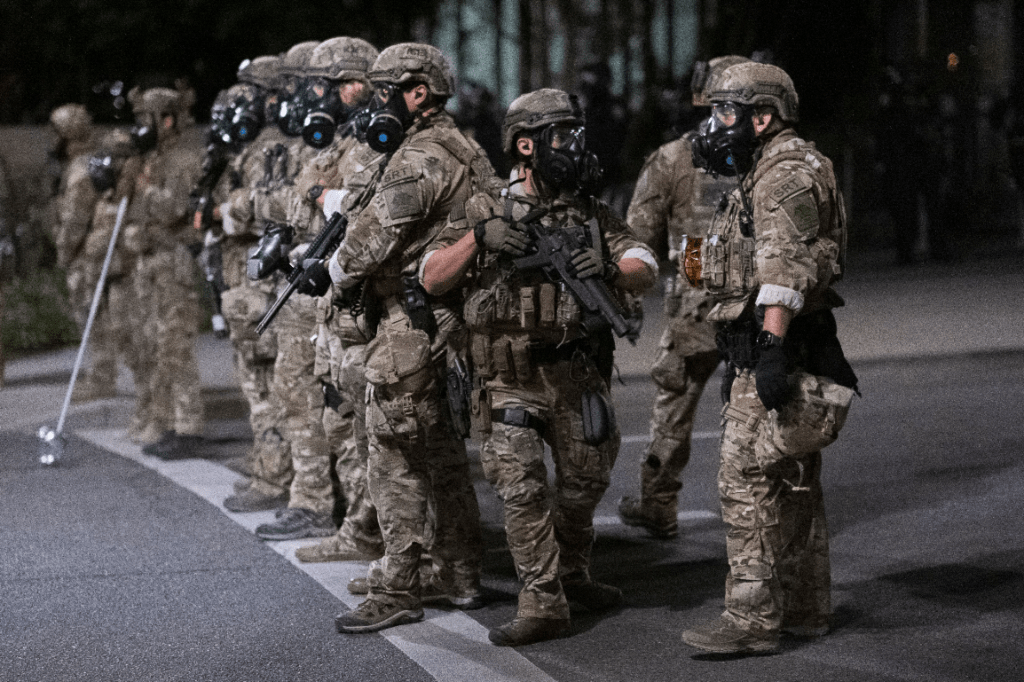
Clashes between protestors and law enforcement officials following the killing of George Floyd have shown how difficult it can be to distinguish law enforcement officials from one another in the protest context.  As a practical matter, because so many officials are present during protests, it is difficult to know who among many fired the rubber bullet, released the tear gas, or swung the baton that injured the putative plaintiff.  And even if one saw the individual, riot gear and SWAT team uniforms often make it impossible to identify the officer. This problem is only compounded by missing or covered badges numbers.  As Attorney General Bar stated, “in the federal system, we don't wear badges with our name -- I mean the agents don't wear badges and their names and stuff like that, which many civilian police ... agencies do.” The U.S. Customs and Border Protection Acting Commissioner explained that this was an intentional decision to conceal the identities of agents because protestors, who he dubs as “violent criminals[,] use this information to target them & their families, putting both at risk.”  Similarly, there are reports from around the country that local officials policing protests covered their names and/or badge numbers.

Portland, Oregon exemplifies the problem of anonymous law enforcement officials.  Earlier this month reports emerged of masked agents wearing camouflage patterns usually donned by Army officers “patrolling areas of Portland—and conducting arrests by scooping suspects up into vans.”  Initially, people had no idea who these law enforcement officials were.  President Trump has since taken credit for sending agents from the Department of Homeland Security to Portland to protect federal property.  More troubling, Trump is considering sending federal agents to other cities “run by very liberal Democrats.”

Not only are unidentified federal officials policing American streets, but there are allegations that their tactics are depriving civilians of their constitutional rights.  Last month, Oregon’s attorney general filed a suit against several federal agencies and “unnamed individual officers” alleging federal officials’ tactics deprived detainees of due process.  The Western States Center (WSC), a Portland-based civil rights organization, filed a federal lawsuit against the Department of Homeland Security (DHS), the US Marshals Service (USMS), Customs and Border Protection (CBP), and the Federal Protective Service (FPS) alleging the “the administration’s actions are unconstitutional” and have “deprived Portlanders the right to protest peacefully.”  Additionally, last week, “two groups and five individual plaintiffs” filed a complaint against various federal agencies alleging “federal officials deprived protesters of their constitutional rights to free speech, free assembly and due process, and their freedom from unreasonable seizure.”

The purpose of the George Floyd Justice in Policing Act is to hold law enforcement officials accountable.  One implicit goal of Section 102 is to increase the likelihood that law enforcement officials --- regardless of whether they are local or federal --- will be accountable to the persons they injure.  To this end, legislators are right to eliminate the qualified immunity defense.   But doing so is largely futile if law enforcement officials can hide behind masks and shields. Anonymity offers officials a new, more powerful form of immunity.  You can’t sue someone when you don’t know who they are.  And although federal police are withdrawing from Oregon, we must ensure that anonymity does not replace qualified immunity as a shield to liability.

Protecting Workers Through Publicity During the Pandemic

The COVID-19 pandemic has been devastating for many workers earning low wages and their families. Workers are risking their health and lives, including in meatpacking plants, grocery stores, restaurants, mass transit, and health care. Black workers, in particular, are experiencing retaliation for raising COVID-19 workplace safety concerns. Millions of workers are struggling to make ends meet after being laid off and need unemployment insurance. Other workers have been deemed essential, but their employers have not provided them living wages or critical benefits like paid sick days. While federal and state laws are in place to protect and support workers during the pandemic in various ways, many workers don’t know about these laws or programs. Similarly, employers may not realize their legal obligations. Using media and strategic communication was a critical tool for labor enforcement agencies before the pandemic--and it is of even greater urgency now.

To help agencies with this aspect of their work, the Center for Law and Social Policy (CLASP) and the Harvard Law School Labor and Worklife Program released a toolkit earlier this month, Protecting Workers through Publicity: Promoting Workplace Law Compliance through Strategic Communication. The toolkit shares research showing that media coverage and public disclosure improves policy outcomes, in labor and other contexts. The toolkit can be used by labor enforcement agencies, as well as policymakers who care about worker issues, to help them use media effectively. It will also benefit worker advocates, who can share it with enforcers and policymakers as part of an effort to press for greater use of this underutilized vehicle for driving compliance.

In response to the pandemic, Congress passed three stimulus bills and created new benefits, rights, and programs for the workplace. The federal measures included new unemployment insurance provisions, access to paid sick days, and paid leave. States and localities have also responded to the moment, passing new laws to help fill gaps left by the Trump administration. The effectiveness of these new measures will be jeopardized, though, if working people don’t know that enforcement agencies will hold employers accountable for retaliation or violating the law. Agencies can use proven communications strategies to fill knowledge gaps and advance the goals of workplace safety laws.

For a recent example of the importance of communications, consider the newly created paid sick days and paid leave benefits in the Families First Coronavirus Response Act and The Coronavirus Aid, Relief, and Economic Security (CARES) Act. Data shows limited awareness of these key provisions among both workers and employers:

  • In one survey, nearly half of people had heard very little or nothing about these benefits.
  • Only 28 percent of businesses covered by the law reported that they were taking advantage of available tax credits to reimburse employee paid leave.
  • In another poll, only one in five voters had taken or planned to take advantage of these paid leave provisions.
  • Many workers report fear of retaliation from their employers (even though the federal government will reimburse employers for this paid sick leave).

A lack of outreach has undermined the law’s critical goals. With better public communication, more workers would be aware of their rights and the government’s role in upholding them. Paid sick days are crucial for working people. They are also essential to protecting public health because paid sick days ensure that workers can comply with orders necessary to stop the spread of the virus. The new toolkit offers agencies concrete approaches and tools to elevate these new protections through a media and public communications strategy.

The toolkit also highlights research demonstrating the deterrent impact of media coverage. For example, a study released in June examined the impact of press releases issued by the Occupational Safety and Health Administration (OSHA) during the Obama administration. Duke Professor Matthew Johnson found that after a press release was issued about penalties and enforcement against an employer, there were 88 percent fewer violations at later inspections of facilities within a 5-kilometer (roughly 3.1 mile) radius. This effect persisted even with facilities 50 kilometers (roughly 31 miles) away. Overall, the research found that publicizing OSHA violations leads to significant improvements in workers’ safety and health. Studies in other areas (such as air pollution and food safety) have also found a beneficial impact based on media coverage or public disclosure.

In a moment of extreme hardship for workers and reduced state budgets, engaging with strategic communications, including by securing media coverage, is a cost-effective way for agencies to multiply their impact. It can be a critical method to inform workers of their rights, deter violations, and drive compliance with critical workplace protections.


Beyond the Right to Live in the World: A Reflection on the ADA and Disability Law

Jacobus tenBroek penned one of the most formative law review articles in disability rights history, “The Right To Live In The World, in 1966, in which he argued, among other things, that law and society should move from a custodial approach to disability regulation that prioritized segregated residences to an integrationist approach that prioritized mainstream community living. The thirtieth anniversary of the Americans with Disabilities Act (ADA), the civil rights legislation for people with disabilities, underscores the importance of Dr. tenBroek’s legacy as well. His emphasis on integration as the theoretical underpinning of law reform directly influenced key disability rights including Sections 501, 503, and 504 of the Rehabilitation Act of 1973 and the Americans with Disabilities Act. The idea that people with disabilities were entitled to equal opportunity in the same ways as other marginalized groups—such as people of color or women—was nothing short of radical at the time of his article. Dr. tenBroek framed equality for people with disabilities as “the right to live in the world” which, by extension, required physical access to make the right meaningful. While the ADA has undoubtedly transformed the built world by removing architectural barriers, legal scholars and advocates agree that the ADA has been less successful in combatting disability discrimination in other priority areas such as employment.

Three decades after President George H.W. Bush signed the ADA, a bi-partisan achievement, the existence of a “right” to live in the world has proven insufficient on its own to guarantee equal opportunities for people with disabilities. Case in point, Covid-19. The current pandemic has underscored what I call the “frailty of disability rights,” the instability of the rights of people with disabilities when they compete with those of other public interests. Two recent examples illustrate how antiquated social norms and attitudes about disability undermine how disability rights are exercised, interpreted, and enforced. First, consider the ease with which states and private actors dusted off healthcare rationing policies that blatantly discriminated on the basis of disability and age, and how easily such policies passed public muster. Alabama’s standards of care, for instance, classified people with intellectual and developmental disabilities as “poor candidates” for ventilators. If not for the swift legal response from disability advocates and a subsequent settlement, these standards of care would continue to inform medical treatment and rationing in Alabama and in other states. Second, consider how owners and operators of places of public accommodations wrestle with a growing anti-mask movement. Some anti-mask activists erroneously have claimed that the Americans with Disabilities Act exempts them from state and local mask requirements because of underlying health conditions. They have also argued that the ADA and privacy laws such as Health Insurance Portability and Accountability Act prevent business owners or service providers from asking any follow-up questions about disability. To be clear, there are certainly medical conditions that require business owners to provide reasonable modifications to allow individuals with disabilities to access their services; however, the analysis is not categorical. Such assessment would require an individualized examination of whether the person meets a threshold legal definition of disability, and follow explicit procedures enumerated in the ADA and corresponding regulations.

At least three factors continue to limit the remedial reach of disability laws. First, what I have called “the aesthetics of disability”—socially determined physical, sensory, and behavioral markers of disability—trigger affective processes that mitigate interactions with people with disabilities. The degree to which a person claiming disability manifests these limited aesthetic markers—usually assistive devices such as wheelchairs, white canes, prosthetics, or visible affliction and pain taken as proxies for incapacity—determines the legitimacy of their claim to disability identity and the perceived benefits that accompany such status. From parking lots and amusement parks to the courtroom, the aesthetics of disability have become evidentiary cornerstones of legitimate claims to disability. Consider the evidentiary role of Harvey Weinstein’s walker in his sexual assault trial in New York. Also, while upwards of 61 million people in the United States have one or more disabilities, only a small percentage of this number visibly manifest the aesthetics of disability. This can affect whether a person without them wishes to exercise legal rights and entitlements, in part, because these markers influence how factfinders will judge the persuasiveness of their claim to disability.

Second, and relatedly, disability laws have a complicated relationship with privacy. Congress intended the ADA to help address attitudinal barriers that limit access for people with disabilities which requires wrestling with deeply rooted biases against people with disabilities. The actual design of the ADA protects the employee from involuntary disclosures of disability information, including their identity as a person with a disability, in the employment context; however, if the employee voluntarily discloses to others in the workplace, they may lose the broader privacy protections. This means that an employee with a less visible disability, to protect their privacy rights overall, may choose not to disclose disability even when disclosure could benefit both the individual through the accommodations process and the broader normative mission of the ADA. This is part of the reason some anti-mask activists claiming disability exemptions have been so successful. Because people do not understand the nuances and realities of disability, they may be more inclined to be risk-averse without further inquiry when someone presents the possibility of ADA liability. This, in turn, breeds public mistrust about fraud and gaming that leads to public policing of disability rights. I argue in a forthcoming paper that the assumption that disability laws ought to value privacy as a default antidiscrimination tool requires interrogation, in part, because of the negative externalities it has produced—e.g., information deficits about disability, stigma, and the perpetuation of the aesthetics of disability in law. This is not to say that we should deregulate the disclosure of medical information or force people with less visible disabilities to disclose disability identity in service of meta-antidiscrimination goals; rather, in the design of legislation and regulation of disability, we must actively debate the stakes of nudging privacy over publicity.

Third, the ADA’s statutory focus on individual remedies over structural reforms has constrained its impact. The precarious balance between individual rights and systemic change is not unique to disability law. Perhaps, as Professor Jamal Greene argues in his forthcoming book, How Rights Went Wrong, the problem is the rights framework itself that sets up a zero-sum game (perceived or real) and breeds social discontent. This global explanation is certainly plausible and applicable to disability, but I would argue that disability law takes individualization a step further. The ADA emphasizes individual assessment to avoid categorical generalizations that treat all people with disabilities as incapable, frail, and pitiable. Key ADA legal tools such as reasonable accommodations and even the “direct threat” defense demand an individualized analysis to ensure that people with disabilities have access to work, places of public accommodations, and public programs and services. Congress focused on individualization because of the pervasiveness of stereotypes about particular disabilities, some that may be highly stigmatized such as HIV/AIDS or, perhaps, Covid-19.

How do we address the deficiencies of the ADA in creating a right to live in the world? To begin to answer this question, I return to Dr. Jacobus tenBroek. Dr. tenBroek was intimately tied to the civil rights movement for racial justice. Thurgood Marshall, at the time special counsel for the NAACP rearguing Brown v. Board of Education, wrote to Dr. tenBroek to discuss tenBroek’s abolitionist theories of constitutional interpretation of Section One of the Fourteenth Amendment. Dr. tenBroek’s work viewed segregation as antithetical to the constitutional guarantees of equal protection. This is the connection between his disability related work and his constitutional abolitionist work. Justice Thurgood Marshall would later go on to dissent in City of Cleburne v. Cleburne Living Center, Inc., reasoning, in part, that people with intellectual and developmental disabilities are a discrete, insular class of people who have been subjected to extraordinary discrimination, segregation, and neglect like other marginalized groups. This recognition of interdependence, historic subordination, and shared vulnerability is the future of disability justice in the United States. The coexistence of Covid-19 and Black Lives Matter in the public mind has created space to connect the dots.  From policing to Covid-19’s effect on prisons and nursing homes, people of color, are disproportionately affected. Yet modern disability rights movements have not yet fully grappled with internal racism and the potential for an antiracist and anti-ableist approach to social justice.

But what is the proper role of law in this? It is complicated and not my intent to resolve these issues here. However, public discourse around abolition versus reform offers an interesting entry point that resonates with disability advocates. Take prison abolition. The demise of large-scale, congregate residential institutions that served people with intellectual and developmental disabilities in the 1970s, for example, may offer insights into the broader decarceration movement. In many ways, modern abolitionists advance universal design thinking, that is, rather than retain a deeply flawed institution and make tweaks to accommodate individuals in this system, we ought to rethink the entire system, critique its goals, and address the socio-political and economic inequities that lead to incarceration in the first place. This could include revisiting the importance of constitutional law (both state and federal) to the advancement of disability equality. This moment feels different. Everyone is reimagining how and why institutions exist and operate as they do. Integration remains a critical governing principle in disability law, now more than ever. Dr. tenBroek’s legacy, however, demands that we move beyond the mere right to live in the world and ask not what we need to live in this world but what kind of world we want to live in.