Black History Month: Continue the Conversation

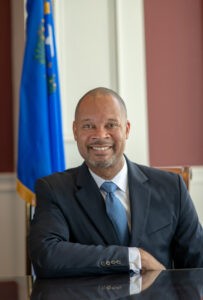
Headshot of Aaron Ford
Aaron D. Ford, Nevada Attorney General

Every February, my family and I celebrate Black History Month. For the Fords, Black History Month begins with a conversation. We discuss the pertinent happenings of our time; we talk about great black leaders; and perhaps most importantly, we take the time to thank and recognize those around us who in different ways have been a part of black progress.

For me, Black History Month isn’t just a date to calendar every year. This month is rooted in black struggle. A few years ago, I learned that an ancestor of mine, William Berry, was on the auction block in Fordyce, Arkansas. That day he protested his own sale saying, “I will not be treated like cattle. You will not sell me and separate me from my family.” Unfortunately, his words were not met with mercy. Instead, he was killed on the spot and his three young sons were sold to slavers in Texas. One of those sons is my great, great, great grandfather. This story of my ancestry really gave new meaning to my plight for equality. In a time when black men, women and children were silenced, William stood up for his own humanity. He said ‘no’ to slavery and inequality, even at the expense of his own life.

I was elected to office about two years ago as the first African American attorney general in Nevada and the first African American to hold statewide constitutional office in Nevada. It is, without a doubt, the honor of a lifetime, and I don’t take my representation in the African American community lightly. William’s story has become a mantra for me in my day-to-day work. It serves as a reminder of where I came from—both as an African American and as a Ford. But it also reminds me that there are so many individuals, families and communities that struggle and that are vulnerable. Irrespective of what backlash I may face for my choices and decisions while in office, I am determined to stand up for those who need a voice and a platform, and am determined to seek out justice at every available corner.

In thinking about what I wanted to share with you about Black History Month, I went back to the roots of black history to Carter G. Woodson who many consider to be the “Father of Black History.” Born in 1875 to former slaves, Woodson was the second African American to earn a doctorate from Harvard. He was unable to attend school for much of his childhood and began high school at age 20. He had to put off schooling while he worked in the coal mines of West Virginia, and went on to earn degrees from Berea College, the University of Chicago and Harvard. In 1926, he created what he called “Negro History Week”, before later going on to lobby extensively to establish Black History Month. Woodson believed that appreciating a people’s history was a prerequisite to equality. He wrote, “If a race has no history, if it has no worthwhile tradition, it becomes a negligible factor in the thought of the world.” What Woodson is so eloquently saying is that no amount of legislation can grant you equality if a country doesn’t value you.

Black History Month is more than just a celebration and it’s more than a commemoration of African American contributions to this country. Black History Month at its core was an effort to establish equality: an effort to highlight and encourage diversity. A time to reflect and think ahead. Black History Month is a reminder that differences should be celebrated not segregated. This month puts a spotlight on the great pioneers before us who have shaped our lives and communities: Rosa Parks, Nelson Mandela, Malcolm X, Maya Angelou, and so many more. And they have provided us with the tools we need to move forward as a community under one human race. Here are some of their words and I hope they will inspire your action.

  • “If you want the cooperation of humans around you, you must make them feel they are important—and you do that by being genuine and humble.” –Nelson Mandela
  • “You must never be fearful about what you are doing when it is right.” –Rosa Parks
  • “When ‘I’” is replaced by ‘we’ even illness becomes wellness.” –Malcolm X
  • “If my mind can conceive it, and my heart can believe it, then I can achieve it.”  –Muhammad Ali

Diversity must always be a conversation that we continue in our daily lives. It’s about what we all bring to the table regardless of our race, age, background and experience. Together, we bring a lot to the table. When I think about Black History Month, I think about love, honor, respect and possibility. As Nevada’s attorney general, I have made it a focus of my administration to protect and advocate for Nevadans of every age, color, creed and background. I use the term “Nevada Family” broadly—whether you’re a three generation Nevadan or you moved to Nevada a week ago, you’re Nevada family. Whether you’re a single mother with two kids or a family of nine, you’re Nevada family. Regardless of whether you’re affluent or indigent, you’re Nevada family, and my office stands ready to help and support you.

To all of you taking the time to read this article, I thank you. Change and diversity require learning and education. They require a conversation—many in fact. And finally, they demand action. Black history should be shared, celebrated and discussed this month and every month, and I hope you will join me in doing just that.

Aaron D. Ford is Nevada's 34th Attorney General and the first African American to hold statewide constitutional office in Nevada.


First But Not Finished...

In this moment in my life—and this Black History month especially—I find myself focusing and reflecting on firsts. I am a first born child of a single mother. I am the first college graduate on my mother’s side. I am a proud member of the first sorority for African American college women. I am the first lawyer in my family. I am the first judge in my family. Being first is such a running theme in my life that my dad often greets me lovingly as “Hello my first!” as if “first” is the name that appears on my birth certificate. I assure you … it does not!

I am a recently elected African American woman judge in Texas. The 2018 election was not my first rodeo, however. Like so many other firsts, my successful journey to the bench involved many hurdles (I am a former hurdler and hurdle coach currently, so settle in for a slew of hurdle analogies). No one—not even myself—would have ever predicted that I would eventually become a judge. Given my background, it was hard enough to envision myself as a lawyer.

I shelved the dream of becoming a judge early in my legal career, more than twenty years ago, when I fully understood how you really become a judge in Texas. I did not have the generational Texas family history, wealth, or connections to make it happen. With the dream shelved, I turned my focus on trial experience, partnership election, community service, and family. It was not until someone approached and encouraged me to take my dream off the shelf in 2009, and later in 2013, that I first ran for judge. I campaigned hard in 2014 and crisscrossed the 1,778 square miles of Harris County. I lost.

Losing was painful. However, like an inevitable fall or scrape on a hurdle, you have to right yourself quickly, gather courage, and tackle the next inevitable hurdle to the finish. After grieving my loss and giving my family time to recover from politics, I ran again in 2018 and won. I am fortunate to be a part of the history making diverse group of women judges campaigning together known as the “Houston 19.” With our election, we filled every type of judicial seat in Harris County, except for probate, with experienced and qualified African American women judges. Like my own court, many of the new judges were the first in their court. People across America and beyond shared in this historical moment (I saw a self-printed t-shirt of the Houston 19 on a stranger in New Orleans). And, hopefully, we inspire girls and African American children to have the courage to never shelve their dreams and to make necessary changes to the status quo.

Focus on First 

Every single day, I am incredibly honored by and thankful for the awesome and unique privilege of serving as the first African American judge of a 124-year-old district court. I also focus on other firsts such as Thurgood Marshall, who became the first African American Supreme Court justice in 1967. I focus on Jane Bolin, who became the first African American woman judge in the United States in 1939. I focus on Alice Bonner, who became the first African American woman state judge in Harris County, Texas in 1979. I focus on Vanessa Gilmore, who became the first African American woman federal judge in Texas in 1991.

Why focus on the first? Because the particular change brought on by the infusion of judges with the uniquely African American and female experience and perspective is important—and very much needed in our justice system. The mere accomplishment of being the first to change the status quo, immediately changes what we as a society believe is and should be possible.

As a college hurdler, the first hurdle was the most important hurdle to set the pace and tone of your race. Judges are the ultimate interpreters of the rule of law, Constitution, and the independent third branch of government, and as such, they set the tone and pace for the United States of America’s achievement of one of its highest ideals—justice for all. The first judges courageously set and changed the tone and pace of justice in American society. Most of my lawyer experiences in court were very rarely in front of an African American woman judge or even a judge who I believe knew and understood the experiences of African American, female, or poor people.

Then, Focus on the Finish

The work toward achieving a fair, equitable, and just judicial system is not finished. Diverse judges can lead the way in making the system fairer by ensuring all litigants have as much notice as possible to exercise their rights in court. Diverse judges can ensure the equal application of the law to claims or defenses from the richest litigant to the poorest litigant. Diverse judges can also make sure that justice contemplates and includes all by making sure access to the justice system is not limited by the color of a lawyers or litigants’ skin or the lack of resources available to them.

Because of my uniquely African American female experience, I am specially poised to bring positive change to the judiciary in Harris County and Texas. As is my duty as presiding judge, I focus on making sure our trials are devoid of bias—both explicit and implicit—toward litigants, lawyers, witnesses, and participants. I also focus on making sure litigants not represented by counsel are given as much notice about their case as possible. We have increased this particular effort because of the pandemic and the judiciary’s move to electronic, video hearings and cancellations of in-person appearances.

On the rare occasion that I have minors in my court (I do not have family law cases), I take the opportunity to encourage the minors to become lawyers and judges and allow them five minutes of fame to try on my robe, take pictures, and command “order in the court” with my gavel! Given the pandemic, this action has turned into an open invitation to visit the Court when the courts are freely open to the public. I probably enjoy it more than the minors, but I hope they remember it as a positive experience in the courtroom and, because of it, return as lawyers and judges someday.

The future is why the focus on the finish is important. As our newly elected first African American woman vice president Kamala Harris proclaimed, “I may be the first, but I will not be the last.” I hope to leave the court, the judiciary, and this world better than I found it. One hurdle at a time.

The U.S. Rejoins the Paris Agreement: Symbolism or Success?

On Inauguration Day, one of President Biden’s first acts was signing an order enabling the United States to re-join the Paris Agreement on climate change. With the stroke of a pen, President Biden signaled to the international community that after four years of isolationism under former President Trump, the U.S. was ready to reassume its global leadership role.

The United States’ re-entry into the Paris Agreement is not just symbolically important. In fact, it is critical to the treaty’s success and to the global community’s ability to mitigate the disastrous effects of climate change. Turn on the news on any given day and you can see the catastrophic consequences of extreme weather, such as floods, droughts, severe heat, or most recently, Arctic temperatures in southern states. Climate change also has disproportionate impacts on vulnerable and marginalized communities, raising environmental justice concerns.

U.S. leadership on global climate change is crucial because the Paris Agreement is structured around voluntary targets and peer pressure.  Each country sets its own goals, which are called “Nationally Determined Contributions” (NDCs). Thus, when President Trump railed against the “unfair economic burden” of the Paris Agreement, he was actually criticizing the targets set by the Obama administration. When he complained that the Agreement unfairly gave China an advantage, what he really meant was that China’s voluntary targets were less ambitious than those of the U.S.  In fact, President Trump arguably could have kept the U.S. in the Paris Agreement but submitted a less stringent NDC that was more in line with the goals of China.

The Paris Agreement operates on peer pressure because the only internationally mandated rules relate to the disclosure and monitoring of the voluntary national targets. The parties hoped that a transparent system for accountability would motivate nations to “ratchet up” the ambition of their goals. By withdrawing, Trump dis-incentivized ambitious climate targets and created a leadership vacuum that other nations tried to fill.

For those familiar with the history of international climate policy, the U.S. withdrawal from the Paris Agreement felt like déjà-vu. Two decades earlier, the failure of the U.S. to join the Kyoto Protocol to the U.N. Framework Convention on Climate Change, an international treaty intended to reduce global greenhouse gas emissions, had disastrous consequences. Without U.S. leadership, it took much longer for the treaty to enter into force. The absence of U.S. participation also encouraged defection from the Kyoto Protocol’s targets.

President Biden has sought to turn the tide by making climate change a priority for his administration. He issued several important executive orders, including on Tackling the Climate Crisis at Home and Abroad and on Protecting Public Health and the Environment and Restoring Science to Tackle the Climate Crisis. These orders highlight that climate change is a multi-faceted issue with national security, economic, public health, ecological, and environmental justice dimensions. In addition, President Biden has appointed former U.S. Secretary of State and U.S. Senator, John Kerry, as the Special Presidential Envoy on Climate, making it a cabinet-level position on the National Security Council.  On Earth Day this year, April 22, President Biden will also host a Leader’s Climate Summit.

The U.S. must now lead by example and submit an ambitious new Nationally Determined Contribution under the Paris Agreement.  Unfortunately, the widespread rollback of environmental policies by the Trump administration means that this will not be easy. President Trump undermined just about every initiative that the Obama administration relied upon in its initial Nationally Determined Contribution. These included rollbacks on clean power, vehicle fuel efficiency, energy efficiency for appliances and buildings, and on methane emissions. The Obama administration also hoped to curb highly potent greenhouse gases known as hydrofluorocarbons (HFCs), but the D.C. Circuit, in an opinion written by now-Justice Kavanaugh, limited the EPA’s ability to do that. In rare good news, however, Congress adopted a phase-down of HFCs as part of its 2020 year-end omnibus bill.

The Biden administration can also build on the efforts of states and cities that sought to fill the global leadership void on climate change in the Trump-era. Many blue states played a key role in slowing down Trump’s deregulatory bonanza through litigation filed by state Attorneys General, which often pointed out procedural and administrative law missteps. In addition, many states and cities pledged to uphold the Paris Agreement, thereby acting as subnational “norm sustainers of international environmental law. For example, when a bi-partisan coalition of states called the U.S. Climate Alliance pledged to benchmark their own progress on the U.S. targets under the Paris Agreement, they signaled to other nations that a significant portion of the United States was still committed to the climate treaty’s goals.

The Trump administration sought to stifle these state-led global efforts. For example, in the fall of 2019, the Trump administration sued California over its linked cap-and-trade program with Quebec. The federal government alleged that the cross-border agreement was an unconstitutional treaty or compact, and that it was preempted by federal action, including by Trump’s withdrawal from the Paris Agreement. In its pleadings and briefs, the Trump administration also raised concerns about a host of other state activities on global climate change, including the creation of the U.S. Climate Alliance and statements by state leaders pledging to uphold the Paris Agreement.  Nonetheless, the district court ultimately upheld the constitutionality of California’s cap-and-trade program with Quebec. This litigation underscored Trump’s desire to squelch any and all state efforts on global climate change.

But, what goes around, comes around. As the Biden administration looks to implement its own ambitious environmental goals, it will no doubt face challenges from red states. Indeed, Obama’s signature Clean Power Plan was immediately challenged in court. It was left in legal limbo until it was eventually repealed and replaced by Trump’s Affordable Clean Energy rule. That rule, however, did not stand up in court. On January 19, 2021, the U.S. Court of Appeals for the D.C. Circuit vacated the Affordable Clean Energy rule on the grounds that it “hinged on a fundamental misconstruction” of the Clean Air Act. The court did not expressly re-instate the Clean Power Plan but instead remanded to the Environmental Protection Agency for further proceedings.

If there is one lesson that we can learn from the past two decades, it is that the executive branch cannot go it alone on climate change. President Biden needs to prioritize working with Congress to pass comprehensive climate legislation. Agency action premised on existing statutory authority, like the Clean Air Act, will almost certainly be subject to greater legal challenge. Moreover, as the federal courts have become increasingly conservative, judges may be more skeptical of agency deference on environmental issues. The last serious effort at passing comprehensive climate legislation in 2010 failed. Special Presidential Envoy for Climate John Kerry was a key member of that Senate coalition and should understand this first-hand.  The time to act on climate legislation is now.

It is not yet clear whether the United States’ re-entry into the Paris Agreement on climate change on February 19, 2021 will be remembered as a mere symbol of our country’s renewed aspirations of global leadership or as a moment when we began to make real progress in addressing the climate crisis. As Robert Putnam’s famous two-level game theory posits, domestic politics and international relations are often inextricably entangled, such that leaders must “strive to reconcile domestic and international imperatives simultaneously.” In other words, the U.S. will only be able to catalyze meaningful global action on climate change if it leads by example and reduces domestic greenhouse gas emissions here at home. If the climate crisis has taught us anything, it is that we are all connected.

Correcting Past Mistakes: PPP Loans and Black-Owned Small Businesses

We may be nearing the end of Black History Month but there are always lessons to be learned about the disparate racial impacts of federal programs. There is always time to rectify past mistakes, particularly recent ones. As was recently announced, the Biden Administration is taking steps to more equitably administer the Paycheck Protection Program, but it must do more to reach Black-owned small businesses in particular.

Failing to Reach Black Communities

The CARES Act and Paycheck Protection Program & Healthcare Enhancement Act funded 5.2 million loans, worth $525B from April 3 to August 8, 2020. This money failed to reach Black communities. Data analyzed by the Associated Press shows that nearly twice the number of PPP loans were approved for business owners living in the 20% of zip codes with the greatest proportions of white residents than were approved for business owners living in the 20% of zip codes with the smallest proportions of white residents. Another post-mortem study of PPP loans found that the success rate of white applicants was 60% compared to a success rate of 29% for Black applicants.

The data is unsurprising. Structural racism pervades our financial institutions; while administered by the Small Business Administration, PPP loans are distributed primarily through banks, with the top lenders being large commercial banks, that have a long history of reserving their services for white people and white communities while excluding people and communities of color. Rather than grapple with this structural inequality, Senator Marco Rubio, then Chair of the Senate Committee on Small Business and Entrepreneurship, refused to require the SBA to collect demographic information from borrowers. As a result, 75% of all first- and second-round PPP loans did not include the race of the business owners applicants.

Early Data on Third PPP Loans Not Promising

Despite attempts to rectify the failure of the first- and second-round PPP loans to reach Black-owned businesses, third-round PPP loans have not yet proven more successful in breaking down racial barriers. PPP lenders are still not required to collect demographic data from borrowers. The third round of PPP loans began being disbursed on January 11, 2021. Financial institutions funded 1.8 million PPP loans worth $100B from the start of 2021 through February 19, 2021. This third round set aside at least $15 billion for small community banks, credit unions, and community development financial institutions, intending to reach minority and other underserved businesses. But similar to the first and second rounds of PPP loans, 78.6% of the total value of PPP loans have gone to small businesses that did not report the owner’s race or ethnicity. Of the loans that did report demographic data, 13.6% of the total value of loans went to self-reported white-owned small businesses, 2.9% went to Hispanic-owned businesses, 2.4% went to Asian-owned businesses, 0.8% went to Native-owned businesses, and 1.6% went to Black-owned businesses.

Ditch the Color-Blind Approach

In the highly inequitable society in which we live, a color-blind approach is an inequitable approach; those with privilege, power, and access receive a disproportionately larger share of the pie. As many others have pointed out, when it came time to access PPP loans, businesses that already had strong relationships with the lending banks were the most successful. America’s long history of systemic racism in banking fostered the resulting and foreseeable disparities in PPP loan distribution. The Biden Administration should be applauded for halting PPP loan applications for two weeks for all but the smallest of small business borrowers and for also making PPP loans available to self-employed individuals who are disproportionately people of color. Nevertheless, the Biden Administration and Senator Cardin, the new Chair of the Small Business & Entrepreneurship Committee, need to ditch the color-blind approach. Here are some proposals to stem the PPP’s inequities and reach Black-owned business owners:

Require Demographic Data on Race for Applicants & Loan Forgiveness

As a May 2020 report of the SBA inspector general recommended, the SBA should require lenders to collect demographic data from PPP applicants, including race. Loans without such data should be returned for correction and re-application with the necessary racial demographic data. The SBA inspector general also recommended that the SBA request, but not require, demographic data from PPP borrowers when they apply for loan forgiveness. Given the racial equity failures of the PPP rounds, the SBA should require demographic data of PPP borrowers. We will then get a clearer picture of which small businesses benefitted from the program. The SBA can then use that data to prioritize loan forgiveness in underserved markets, as was originally intended under the CARES Act.

Prioritize Socially and Economically Disadvantaged Businesses for Loan Forgiveness

The CARES Act required the SBA to issue guidance to PPP lenders to prioritize loans to small businesses owned by socially and economically disadvantaged individuals, which includes Black-owned small businesses. As the SBA inspector general noted, the Trump Administration’s SBA never issued this guidance. The SBA should now rectify this problem by issuing such guidance but also by prioritizing the loan forgiveness applications of such small businesses. Black-owned small businesses need to know with certainty that their loans will be forgiven in order to start planning their recovery and next steps, whether that be renegotiating their rents with landlords, relocating to cheaper rental space, hiring new employees, or retooling their websites to grab greater shares of the online marketplace. That certainly will help Black-owned business weather the rest of the pandemic and choose to remain open rather than shutter their businesses or apply for bankruptcy. Process these loan forgiveness applications first and fast. The SBA should also issue an Interim Final Rule instituting a presumption of loan forgiveness for socially and economically disadvantaged borrowers as well as borrowers within low- and moderate-income neighborhoods who either have 10 or fewer employees or borrowed less than $250,000 (these borrowers meet the third-round PPP criteria for certain set-asides).

Improve Long-Term Equitable Lending Infrastructure

In the longer term, the SBA should improve its lending infrastructure by (1) requiring diversity, equity, and inclusion (DEI) training for loan officers in banks that participate in SBA lending programs, and (2) targeting its outreach and lending programs to counties and neighborhoods where data shows the largest declines in Black-owned businesses.

President Biden reversed Former President Trump’s executive order banning federal agencies, contractors, and grant recipients from conducting DEI training. Now is the time for proactive steps to confront white supremacy within American institutions. The SBA should require any bank that participates in SBA programs, including future PPP loans, to adopt a DECI training plan. Loan officers who have not undergone DEI training should not be allowed to process and distribute SBA loans. DECI training is not a panacea, but loan officers need to understand the depths of structural racism and the role that financial institutions play in contributing to the racial economic disparities and the black-white wealth gap.

The third-round PPP uses community banks, credit unions, and CDFIs as proxies for racial and geographic diversity for its lending programs. The SBA should also use Federal Reserve data to map where Black-owned businesses have declined and overlap it with CDC data on communities where Covid-19 has hit the hardest. Then publish that data to lenders who participate in SBA lending programs. In the wake of the Black Lives Matter movement, large commercial banks have committed to helping Black communities. The Biden Administration should help hold them to their commitments through financial partnerships that target future small business lending and investments to Black communities.

Alicia Plerhoples is Professor of Law and Director of the Social Enterprise & Nonprofit Law Clinic at Georgetown Law. She also serves at the Faculty Advisor for the ACS Student Chapter at Georgetown Law. Follow her on Twitter or connect with her on LinkedIn.

How do we reconcile our gratitude for a country that seems bent on oppressing us?

As I reflect on Black History Month this year, I have so many conflicting thoughts and memories. As a young child in Brooklyn and Queens, NY, I had a small American flag that I was so proud of and which my family knew not to touch. I protected it with all the (limited) power and might that I had. Since childhood, I have always thought of the United States as an amazing country. After all, I saw first-hand how good a country it was to my family and me. My parents sacrificed plenty to make it to this country from Guyana. Neither of them had a high school education, but they came to the United States to ensure all their future children would have endless opportunities. And fortunately, we did and continue to have such opportunities.

I hold this gratitude for and faith in my country while at the same time confronting, every day, the defining impact of slavery and racism on my country and its laws.  Experiencing the past four years, in particular, with a racist, sexist president, working with all his enablers to use the power of government to oppress, disenfranchise, and divide, and seeing him garner 74 million votes in the 2020 election, has been heavy and difficult. I’ve been struggling to explain to my mom how and why these past four years, including the January 6th home-grown insurrection on our nation’s capital, have been possible in the country in which she sought and received refuge. How do we reconcile our gratitude for a country that seems bent on oppressing us?

I’ve recently re-read The Fire Next Time by James Baldwin. In the letter to his nephew, Baldwin writes a line that resonates with me: “You were born into a society which spelled out with brutal clarity, and in as many ways as possible, that you were a worthless human being.” This is the hard truth that is no less true today than when Baldwin wrote it. Our country's present day is rooted in our country's history of slavery, racism, and oppression. We do not remedy the harm of that history by ignoring it or downplaying its relevance to our present day. We can and we must be able to both celebrate the achievements and aspirations of this country while also doing the hard work of reckoning with and remedying its legacy of racism.

Bryan Stevenson has been speaking about truth-telling for some time. I agree that to reconcile with the impact of racism today, we must tell the truth about its defining role in our country's yesterday. It’s time for all of us to play a role in getting to the heart of our country’s origins. ACS will begin doing just that in this, our 20th anniversary year. ACS’s principal theme this year is reckoning with our country’s deep historical roots and modern manifestation in racism, including our founding document, the Constitution. Talking truth to power includes addressing how our Constitution, in its various incarnations, has been used to enshrine, legitimize, and perpetuate racism. It is our hope that this is just the beginning to truth-telling. It will be a long, difficult and likely painful journey, but it’s necessary if we hope to ever have a shot at reconciliation.

I call on our entire network to join us for this critical journey ahead. Undertaking this necessary and overdue work with the fantastic ACS network makes me proud to hold our country’s flag as we work toward better days and a more inclusive democracy. Join us on March 2 at 4 p.m. ET for our kickoff event, “Reckoning with the Constitution.” RSVP here.

Public Service Means to "Go Where the Problems Are"

My passion for social justice began with my family history. My father marched at Selma with John Lewis. He participated in “Freedom Summer” in Mississippi to register Black voters and build freedom schools. He desegregated his community college. His father—my grandfather—was a Montford Point Marine, one of the first Blacks to serve in the Marine Corps. My mother counseled students in public schools for three decades. Her mother—my grandmother—worked as domestic help for white families during the Jim Crow era.

My family routinely discussed what citizenship meant to us. It is about active service. The idea that we should do something greater than ourselves and make the world reflect not what it is, but what it ought to be.

With those values firmly rooted, this Black kid born in a small town in Mississippi would go on to attend some of the most elite schools in the country. But the value of making a difference in the lives of others, especially in the arena of civil rights, would be a fire that would continue to burn in me. I played football at Stanford but also led campus protests to protect Black studies programs. I studied abroad at Oxford, but I also interned in the White House Office of the Chief of Staff. I was one of the first Black editors in chief of a journal at the University of Virginia Law School, but I also helped create the Law School’s Center for the Study of Race & Law.

My educational journey taught me an important lesson: personal achievement and service can go hand-in-hand. And you don’t have to wait until you arrive at your destination in order to create your legacy. Rather, each of us can make a positive difference wherever we are, right now.

I began my legal career clerking for two esteemed federal jurists: Judge Carl E. Stewart on the U.S. Court of Appeals for the Fifth Circuit and Judge Alexander Williams, Jr. on the District Court for the District of Maryland. I am the first person in my family to attend law school. Clerking provided me with two lifelong mentors.

After clerking, I began my career in public service through a post-graduate fellowship. I was fortunate to be selected as a Francis D. Murnaghan Fellow, a fellowship named after a former Fourth Circuit progressive jurist. I worked at the Public Justice Center, a Baltimore-based anti-poverty nonprofit dedicated to impact litigation, in its appellate section. During my fellowship, I argued an appeal against a major company for wage abuse and testified before a state legislative body against the state’s felony disenfranchisement law.

I believe public service lawyers should “go where the problems are,” meaning they should be on the front lines of the major social injustices of the day. In 2006, the major civil rights issue of the day was the reauthorization of the Voting Rights Act, perhaps the most important civil rights legislation in America. Voter suppression was and continues to be a problem. I desired to be on the front lines of the fight to combat voter suppression, so I joined the powerful Senate Judiciary Committee. I spent the next four years working as a counsel to Senator Patrick Leahy, the chairman, focused on civil rights, judicial nominations, criminal justice reforms.

During my time on the Judiciary Committee, I helped to negotiate the passage of major social justice legislation. From reducing the sentencing disparities between crack and powder cocaine from 100 to 1 to 18 to 1 to passing the first civil rights protections for the LGBTQ community in the form of a hate crimes statute to enacting into law a bill arming the Justice Department with stronger tools to pursue unsolved, decades-old murders of civil rights activists, I had the chance to work on issues that make a far-reaching impact. In addition, I advised on the confirmation hearings of hundreds of judicial and executive branch nominees, including the historic confirmation hearings of Justices Sonia Sotomayor and former Attorney General Eric Holder.

I next began working at the Justice Department’s Civil Rights Division. I served in the Appellate Section where I briefed and argued civil rights appeals. I am particularly fond of having argued against the Alabama State Solicitor General, where I successfully defended the constitutionality of a civil rights statute. Soon, I joined the Division’s front office to advise on civil rights policy issues. In this role, I advocated before members of Congress and their staffers on civil rights priorities and defended the Division in congressional investigations.

In 2013, I became a federal prosecutor in Seattle. Prosecutors have significant discretion in our justice system to bring or dismiss charges and advocate for appropriate sentences. Motivated by a desire to work from the inside to fix our justice system, it was an honor to serve alongside dedicated career prosecutors.

After the police killing of Michael Brown in Ferguson, Missouri, I believed this was my generation’s Selma moment and I returned to Capitol Hill to once again “go where the problems are” and make a difference. I served as Senator Cory Booker’s senior counsel, where I led all of his criminal justice reform work. I helped to negotiate legislation that would turn into the landmark First Step Act, the first time that Congress would take on mass incarceration and attempt to reduce mandatory minimum penalties that drive over-incarceration. I also worked on legislation addressing police misconduct and helped enact into law a bill on “ban the box” to ensure returning citizens are not discriminated against in federal jobs.

I later became Senator Feinstein’s legislative director. I supervised legislative assistants and served as the principal policy advisor to the Senior Senator for California. I also served as chief of staff to a freshman member of Congress where I helped to establish a new congressional office, led multiple congressional offices, and advised a member of Congress on her political, communications, legislative, and in-district agenda.

My legal journey has been deeply influenced by people along the way who molded my passion for social justice into a deeper understanding of the historical and political context of injustice. I am thankful to have learned from scholars, like Clayborne Carson and Lucius Barker, who taught me to see our brilliant, yet unfinished, multi-racial democracy not as it is, but as it could one day be. “We the People…in order to form a more perfect Union” are not just words from an old parchment whose value no longer resonates. Rather, it is a call to action that serves to inspire the present. And each of must do our part to make this Union more perfect.

I became a lawyer because I was moved by the actions of civil rights lawyers before me. I admired people like Charles Hamilton Houston who created the legal strategy to end legalized segregation to Thurgood Marshall and Constance Baker Motley who fought to end America’s Jim Crow legacy to A. Leon Higginbotham whose seminal book Shades of Freedom described both the potential of the law to either eliminate or perpetuate racial injustice. I recall Mr. Houston’s profound statement that a “lawyer is either a social engineer or a parasite to society,” and I desired to use my legal career to become an agent of social change.

Even in the private sector, I have continued to fight the good fight. Following the police killing of George Floyd, who was from my hometown of Houston, I once again wanted to “go where the problems are” to work on the issue of police reform. As a counsel at a global law firm, I represented a national civil rights nonprofit organization in advocating before Congress for the passage of the George Floyd Justice in Policing Act, the major legislation that passed the House of Representatives last year seeking to reform how we do policing in America. I have also counseled nonprofits on civil rights and criminal justice reform legislation.

As activism on police violence and justice reform sweeps our nation, we face a moral imperative to reimagine our justice system. We lock more people behind bars than any place on Earth. We have more people of color behind bars or on supervision than all the slaves in 1850. And we strip millions of people of their basic civil rights, including the rights to vote, serve on juries, and to be free of legal discrimination in jobs, housing, and public benefits. To paraphrase Professor Michelle Alexander, the notion that once a person commits a crime, they are rendered permanently disposable is the very idea that has rationalized mass incarceration.

We are all complicit when we tolerate injustice. Yet, we remain agnostic to the powerful forces that allow mass incarceration to devastate communities and destroy human potential. Perhaps the most harmful racial implication of mass incarceration is that it frames Black people as the problem. We define Blacks as criminals when they stand at the bus stop, sit with friends in a local coffee shop, jog in a suburban neighborhood, or simply walk home from work. This must cease. We must move away from sympathy to action. We must move from thinking of reforms to thinking about reimagining policing, which requires that we ask ourselves a basic but fundamental question: what does society want police to do? And we must recognize, as police have been telling us for decades, that we require them to do too much. In the end, how we choose to fix or not fix our broken justice system—which undermines basic human dignity—is the human rights challenge of our time.

One of my heroes, Rep. John Lewis, once said that “Democracy is not a state, it is an act.” This means that we must choose to actively participate in ensuring our democracy lives up to its promises. That is why I believe in the American Constitution Society’s mission to promote progressive values is needed now, more than ever. As we celebrate Black History Month, I have every confidence that ACS will continue to lead the way in promoting the progressive values that continue the centuries-long struggle to create a truly inclusive democracy.

Roscoe Jones is a counsel at Gibson Dunn. He has advised three US Senators and a member of Congress. He teaches at the University of Michigan and Yale Law Schools and taught at the Harvard Kennedy School and Georgetown University Law Center. He serves on the Board of the American Constitution Society