
The Roberts Court’s Demolition of Voting Rights
The Roberts Court’s Demolition of Voting Rights
August 2026
Ten years ago, ACS released a program guide entitled “Are All Voters Created Equal?.” As the nation prepares for the 2026 midterms, another critically important federal election cycle, it is worth a look back at this document to reflect on just how methodically the Roberts Court has taken apart federal voting rights protections since the cataclysmic Shelby County v. Holder decision in 2013. After over a decade of this piece-by-piece evisceration of the Voting Rights Act of 1965 (“VRA”) and other key pieces of pro-democracy legislation, it is impossible to look at the damage wrought by the Court’s jurisprudence and answer the question posed by the 2016 guide with anything but a simple “no.” But real questions remain about how to move forward in this next phase in the fight for voting rights to secure access to the ballot box for all voters, regardless of race, gender, or zip code, and meaningful opportunities for representation at all levels of government and the right to have one’s voice heard.
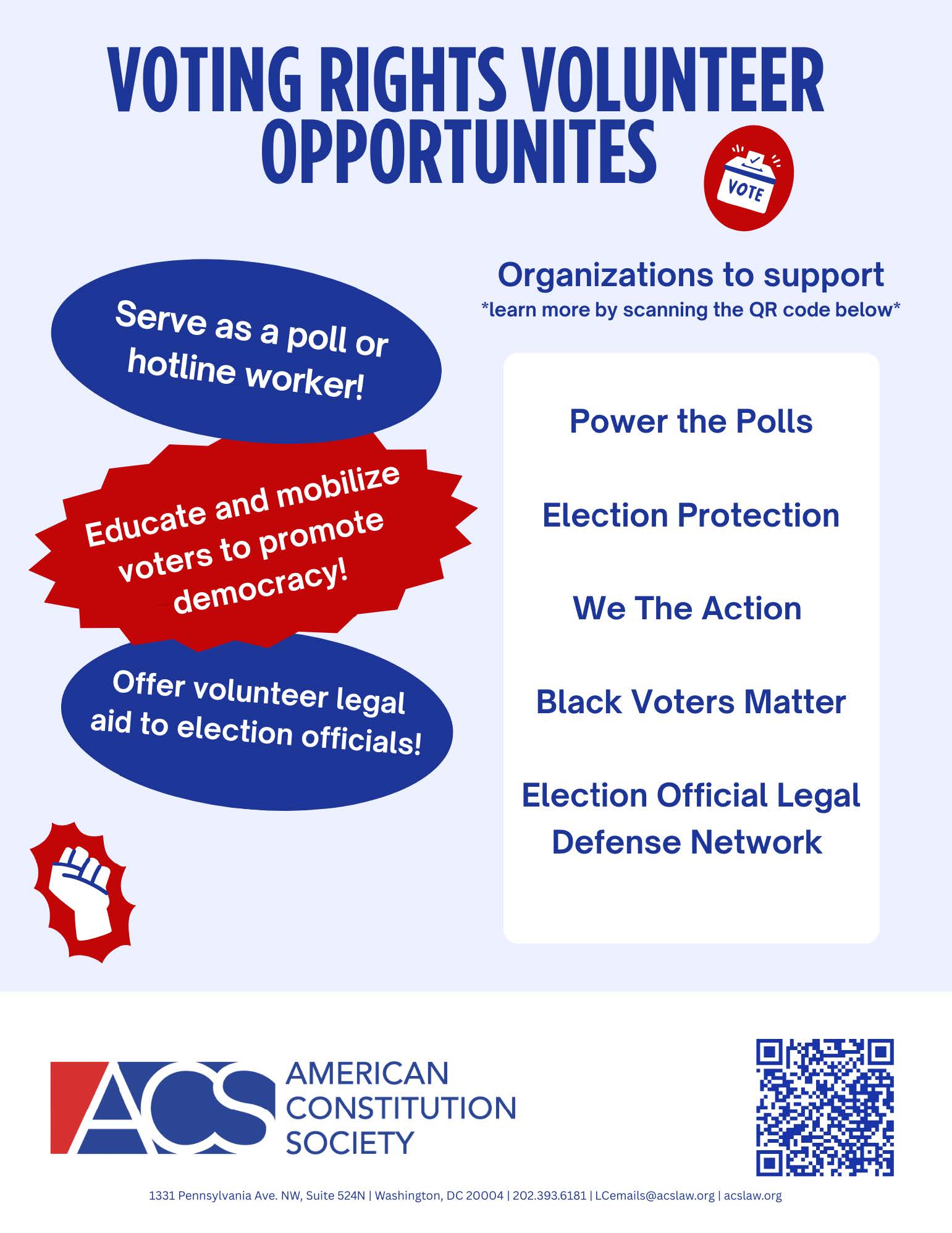
Given the importance of this year’s elections, ACS encourages chapters to host events on the current state of federal and state election laws and relevant constitutional provisions. This brief guide and the accompanying Speakers List are designed to assist in planning such events but are far from exhaustive. While this document focuses on three cases from the Court’s 2025-2026 term, there are many other worthwhile topics to take up in this space. Recent program guides can provide additional suggestions to consider, and as always, ACS staff is available to help. No matter the substantive focus, we encourage chapters to include a call to action as part of their programming. Included in this guide is a flyer highlighting volunteer opportunities that you are free to use.
I. Redistricting post-Callais
Most notable from the Court’s most recent term is the disastrous decision in Louisiana v. Callais. Following the 2020 Census, which showed that Black residents comprised roughly one-third of Louisiana’s total population, the state legislature passed a new congressional map that included only one majority-Black district out of six total districts. A group of Black Louisiana voters and civil rights organizations challenged the map under Section 2 of the VRA claiming vote dilution. Section 2 prohibits states and localities from using an electoral practice or procedure, if doing so would “result in a denial or abridgement of the right of any citizen of the United States to vote on account of race or color.” Federal courts agreed that the map likely violated Section 2 and ordered the state legislature to adopt a new map that complied with the VRA. Louisiana legislators passed a second map in response, one that created a second majority-Black district. A different set of plaintiffs, including Mr. Callais, challenged the second map as an unconstitutional racial gerrymander because it considered race while drawing a second opportunity district for Black voters. After hearing argument during the 2024-2025 term, the Court held the case over and asked for re-argument on the constitutionality of Section 2. In a 6-3 decision, the Court sided with the Callais voters and found that the map creating a second Black-majority district was unconstitutional.
The VRA is one of the single most important and successful pieces of legislation in our nation’s history, dismantling barriers to the ballot box and creating opportunities for a more representative government for voters of color and other underrepresented communities for decades. Writing for the majority in Callais, Justice Samuel Alito claimed to simply be narrowing the test applied to Section 2 claims. But in reality, the test is now illusory. Plaintiffs are no longer able to rely on a showing of racially discriminatory effects of a given map but rather must show intentional racial discrimination and that legislators were not pursuing partisan goals, a defense created by the Court itself. The decision represents the “now-completed demolition of the Voting Rights Act,” as noted by Justice Elena Kagan in her powerful dissent.
Before the ink had dried on the decision, conservative state legislators in Southern states raced to eliminate districts held by Black representatives with claims to be in pursuit of partisan advantage. Louisiana suspended an election already underway to enable conservatives to draw a new congressional map. One month later, in an unsigned order issued on its shadow docket, the Court allowed Alabama to use a congressional map that lower courts had found to be racially discriminatory. Justice Sotomayor wrote in dissent that in allowing the map to be used in spite of the lower courts’ findings, the Court “debases the democratic process by upending Alabama’s entire election in the name of permitting Alabama to discriminate against Black Alabamians. It also corrodes the rule of law by rewarding Alabama’s gamesmanship and outright defiance of court orders.”
Discussion Questions
What does the shadow docket decision in Allen v. Milligan (2026) portend for the future of cases involving intentional racial discrimination against Black voters and other racial minority groups? In Callais, the Court did not address enforcement by private right of action—what avenues remain available to voters and civil rights organizations seeking to vindicate voting rights? What reforms are best to implement at which level? How should litigators approach the distinction the Court has purported to make between partisan versus racial gerrymandering? What can be done by advocates, including law students, outside of the courts to create more equal access to meaningful representation? Are State VRAs the way forward? What does a shift from an “effects” test to an “intentional discrimination” test mean practically for plaintiffs in lower federal courts?
II. Access to the Ballot Box and Fair Counting after Watson v. RNC
As election administrators throughout the country adapted to the COVID pandemic, many states amended their election codes to allow for expanded access to absentee ballots and/or vote by mail. Mississippi was one such state. State legislators enacted a law that permits election administrators to count absentee ballots postmarked by Election Day but received on or within five business days of the election. After unsubstantiated claims from Donald Trump that absentee voting is more prone to voter fraud, the Republican National Committee and conservative state party organizations and voters challenged the law in early 2024, arguing that federal statutes that establish a federal Election Day preempt the state’s law. In a 5-4 decision, the Court held in Watson v. RNC that the federal statutes did not set a deadline for ballot receipt and therefore did not prevent states like Mississippi from counting ballots received by the state’s deadline. Writing for the majority, Justice Amy Coney Barrett emphasized the narrowness of the Court’s holding, writing that “this case is not a case about the Constitution. We do not consider the scope of Congress’s authority to regulate federal elections.” A decision for the RNC in this case likely would have thrown election administration into chaos this election cycle, with 30 states having to sort through compliance while primary elections were ongoing and midterms rapidly approaching. The narrow decision averted such chaos and ensured that voters who cast their ballots in compliance with their state’s law will have their votes counted. However, as election law expert Rick Hasen has noted, “people can rightly celebrate voters’ minor victory in Watson. But don’t mistake the Watson ruling for some indication that the [C]ourt stands ready to read federal and state election laws to protect voters.” During oral arguments in Watson, several of the Court’s more conservative members expressed opinions on the issue of voter fraud that would not have been out of place during a Fox News broadcast. And while the narrow win this term is unarguably positive, the Court has agreed to hear a case next term, RNC v. Mi Familia Vota, over whether the state of Arizona can reject voter registration applications from otherwise eligible voters who do not provide proof of citizenship during the registration process. And in the shadow of Brnovich v. DNC, real questions remain about how the Court might view reauthorizations of the Voting Rights Act or other expansive pro-democracy federal legislation.
Discussion Questions
What does Watson tell us about the Court’s current approach to state authority to oversee election administration? What role, if any, does the Court believe it should play in safeguarding elections and voting rights? What role does the Court believe Congress should play?
III. Campaign Finance in the wake of NRSC v. FEC
The Federal Election Campaign Act restricts the amount of spending political parties can make in coordination with candidates. In 2022, four elected officials, the National Republican Senatorial Committee and the National Republican Congressional Committee challenged these limits on coordination, claiming their First Amendment rights were being violated. In a 6-3 decision in NRSC v. FEC, the Court struck down the limits, holding that coordinated spending is a form of political expression and association protected by the First Amendment. The decision is the latest in a series of cases that have opened the floodgates to corporate and wealthy donors, reshaping the public square and our elections.
Discussion Questions
The Court distinguishes between contributions versus expenditures in its analysis in NRSC—is there a practical significance when it comes to preventing corruption? Is there a meaningful path forward for campaign finance regulation at the federal level? Should reforms focus on non-spending limits like stricter disclosure or public financing?
Speakers List
The following list includes a variety of scholars, advocates, and litigators you may contact when planning your chapter’s events this year. The speakers are listed in alphabetical order according to last name. We have provided their title, organization, and the areas covered by this guide that are most relevant to their work. These categories are necessarily simplistic. When considering any of the experts listed below for your programming, we encourage you to research the speaker to ensure their specialties align with the goals of your event.
This speakers list is not exhaustive. Instead, it is intended to provide you with a sampling of the scholars, advocates, institutions, and organizations that work on these issues. When developing your events, you should also consider local experts and practitioners and consult law school faculty members, including ACS student chapter faculty advisors, for additional suggestions.
| Name | Title | Organization | State | Specialty |
|---|---|---|---|---|
| Debo Adegbile | Partner | WilmerHale | NY | Redistricting, Voting Rights |
| Arthur Ago | Director of Strategic Litigation | Southern Poverty Law Center | DC | Redistricting, Voting Rights |
| Jessie Allen | Professor of Law | University of Pittsburgh | PA | Election Administration, Voting Rights |
| Angelo Ancheta | Senior Research and Policy Counsel | Demos | CA | Election Administration |
| Nicole Austin-Hillery | President & CEO | Congressional Black Caucus Foundation | DC | Voting Rights |
| Dmitry Bam | Professor of Law | University of Maine School of Law | ME | Election Law, Judicial Elections |
| Matt Barreto | Faculty Director, UCLA Voting Rights Project; Founding Faculty Director, UCLA LPPI; Professor, Departments of Political Science and Chicana/o & Central American Studies | UCLA | CA | Voting Rights |
| Richard Briffault | Joseph P. Chamberlain Professor of Legislation | Columbia Law School | NY | State & Local Government Law, Voting Rights |
| Guy-Uriel Charles | Charles Ogletree, Jr. Professor of Law | Harvard Law School | MA | Election Law |
| Travis Crum | Treiman Professor of Law | Washington University in St. Louis School of Law | MO | Voting Rights |
| Katherine Culliton-González | Chair, HNBA Committee for American Democracy | Hispanic National Bar Association | DC | Redistricting, Voting Rights, Equal Access to Citizenship |
| Gilda Daniels | Professor of Law | University of Baltimore School of Law | MD | Election Law, Voting Rights |
| Jacqueline de León | Senior Staff Attorney | Native American Rights Fund | CO | Voting Rights |
| Armand Derfner | Partner | Derfner & Altman | SC | Redistricting, Voting Rights |
| Atiba Ellis | Morris G. Shanker Professor of Law, School of Law | Case Western Reserve University School of Law | OH | Election Law, Voting Rights |
| Christopher S. Elmendorf | Martin Luther King, Jr. Professor of Law | University of California Davis School of Law | CA | Voting Rights |
| Alec Ewald | Professor | University of Vermont | VT | Felon Disenfranchisement |
| Patty Ferguson-Bohnee | Associate Dean for Inclusive Excellence; Charles M. Brewer Professor of Trial Advocacy; Faculty Director, Indian Legal Program; Director, Indian Legal Clinic | Arizona State University Sandra Day O’Connor College of Law | AZ | Election Law, Voting Rights |
| Luis Fuentes-Rowher | Associate Dean for Research and Faculty Affairs; Professor of Law; Class of 1950 Herman B Wells Endowed Professor | Indiana University Maurer School of Law | IN | Voting Rights |
| Anthony Gaughan | Kern Family Chair in Law | Drake University Law School | IA | Election Law |
| Michael Gilbert | Perre Bowen Professor of Law; Martha Lubin Karsh and Bruce A. Karsh Bicentennial Professor of Law; Director, Karsh Center for Law and Democracy | University of Virginia School of Law | VA | Voting Rights |
| Nicholas Gothard | Senior National Coordinator, Election Protection | Lawyers’ Committee for Civil Rights Under the Law | DC | Voting Rights |
| Rebecca Green | Professor of Law and Director, Election Law Program | William and Mary School of Law | VA | Election Law |
| Jamal Greene | Dwight Professor of Law | Columbia Law School | NY | Election Law, Voting Rights |
| Alex Gulotta | Arizona State Director | All Voting is Local | AZ | Election Law, Voting Rights |
| Kevin J. Hamilton | Partner | Ashurst Perkins Coie | WA | Voting Rights |
| Richard Hasen | Professor of Law; Director, Safeguarding Democracy Project | UCLA School of Law | CA | Election Law, Voting Rights |
| Michael Herron | Remsen 1943 Professor of Quantitative Social Science | Dartmouth University | NH | Election Administration |
| Darren Hutchinson | Professor of Law and John Lewis Chair for Civil Rights and Social Justice | Emory Law School | GA | Constitutional Law, Voting Rights |
| Sherrilyn Ifill | Founding Director of the 14th Amendment Center for Law & Democracy | Howard University | DC | Voting Rights |
| Elizabeth M. Iglesias | Professor of Law | University of Miami School of Law | FL | Voting Rights |
| Samuel Issacharoff | Bonnie and Richard Reiss Professor of Constitutional Law | New York University School of Law | NY | Voting Rights |
| Michael S. Kang | Class of 1940 Professor of Law | Northwestern Pritzker School of Law | IL | Campaign Finance, Election Law, Judicial Elections |
| Pamela S. Karlan | Kenneth and Harle Montgomery Professor of Public Interest Law; Co-Director, Supreme Court Litigation Clinic | Stanford Law School | CA | Constitutional Law, Election Law, Voting Rights |
| Ellen D. Katz | Ralph W. Aigler Professor of Law | University of Michigan Law School | MI | Election Law |
| David Kimball | Professor of Political Science | University of Missouri–St. Louis | MO | Election Administration |
| Sophia Lin Lakin | Director, Voting Rights Project | ACLU | DC/NY | Voting Rights |
| Jessica A. Levinson | Clinical Professor of Law; Director, Public Service Institute; Director, Journalist Law School | Loyola Law School | CA | Election Law |
| Justin Levitt | Professor of Law (former White House/DOJ) | Loyola Law School Los Angeles | CA | Voting Rights |
| Michael Li | Senior Counsel, Democracy Program | Brennan Center for Justice | NY | Redistricting, Voting Rights |
| Adam Lioz | Senior Policy Counsel | Legal Defense Fund | DC | Campaign Finance, Election Law, Voting Rights |
| William P. Marshall | William Rand Kenan, Jr. Distinguished Professor of Law | University of North Carolina School of Law | NC | Campaign Finance, Election Law |
| Eugene Mazo | Associate Professor of Law; Associate Professor of Political Science | Thomas R. Kline School of Law | PA | Election Law, Voting Rights |
| Terry Ao Minnis | Vice President of Census and Voting Programs | Asian Americans Advancing Justice | DC | Voting Rights |
| Lori Minnite | Associate Professor of Public Policy | Rutgers University | NJ | Election Administration |
| Spencer Overton | The Patricia Roberts Harris Research Professor of Law | George Washington University Law School | DC | Election Law |
| Nina Perales | Vice President of Litigation (also Lecturer on Law at Harvard Law School) | Mexican American Legal Defense and Educational Fund | MA | Voting Rights |
| Nathaniel Persily | James B. McClatchy Professor of Law | Stanford Law School | CA | Campaign Finance, Election Law, Redistricting, Voting Rights |
| Richard H. Pildes | Sudler Family Professor of Constitutional Law | New York University School of Law | NY | Election Law, Redistricting, Voting Rights, Separation of Powers, Presidential Powers |
| Angie Pitha | Project Lead, Election Official Legal Defense Network | The Center for Election Innovation & Research | CO | Election Administration |
| Michael Pitts | IU Indianapolis Chancellor’s Professor | Indiana University McKinney School of Law | IN | Election Law, Redistricting, Voting Rights |
| D. Theodore Rave | The Bernard J. Ward Centennial Professorship in Law | The University of Texas at Austin School of Law | TX | Voting Rights |
| Davin Rosborough | Deputy Director, Voting Rights Project | American Civil Liberties Union | NY | Election Law, Voting Rights |
| Bertrall Ross | Professor of Law | UC Berkeley School of Law | CA | Constitutional Law, Election Law |
| Thomas A. Saenz | President and General Counsel; Lecturer on Law | Mexican American Legal Defense and Educational Fund; Harvard Law School | CA | Redistricting, Voting Rights |
| David Schultz | Distinguished University Professor of Political Science and Legal Studies | Hamline University | MN | Election Law |
| Steven D. Schwinn | Professor of Law | University of Illinois Chicago School of Law | IL | Campaign Finance, Redistricting, Voting Rights, Separation of Powers |
| Christopher B. Seaman | Robert E.R. Huntley Professor of Law | Washington and Lee University School of Law | VA | Election Law, Voting Rights |
| Miriam Seifter | Richard E. Johnson Bascom Professor of Law; H.I. Romnes Fellow; Co-Director, State Democracy Research Initiative | University of Wisconsin Law School | WI | Democracy and Voting, State Constitutional Law |
| Joshua Sellers | Professor | The University of Texas at Austin School of Law | TX | Voting Rights |
| Kate Shaw | Professor of Law | Penn Carey Law | PA | Campaign Finance, Election Law, Separation of Powers, Presidential Power |
| Theodore Shaw | Julius Chambers Distinguished Professor of Law and Director of the Center for Civil Rights | University of North Carolina School of Law | NC | Voting Rights |
| Daniel Smith | Professor of Political Science | University of Florida | FL | Direct Democracy |
| Fred O. Smith, Jr. | Professor of Law | Stanford Law School | CA | Constitutional Law, Federal Courts |
| Paul Smith | Senior Advisor for CLC and Visiting Professor, Georgetown Law | Campaign Legal Center | DC | Redistricting, Voting Rights |
| Douglas Spencer | Professor of Law; Ira C. Rothgerber Jr. Chair in Constitutional Law | University of Colorado Law School | CO | Voting Rights |
| Nicholas Stephanopoulos | Kirkland & Ellis Professor of Law | Harvard Law School | MA | Election Law |
| Franita Tolson | Dean and Carl Mason Franklin Chair in Law | University of Southern California Gould School of Law | CA | Constitutional Law, Election Law |
| Ciara Torres-Spelliscy | Professor of Law | Stetson University College of Law | FL | Campaign Finance, Constitutional Law, Election Law, Birthright Citizenship |
| Arturo Vargas | Chief Executive Officer | National Association of Latino Elected and Appointed Officials (NALEO) | CA | Redistricting, Voting Rights |
| Tova Andrea Wang | Director of Research Projects in Democratic Practice | Ash Center for Democratic Governance and Innovation | MA | Election Law, Voting Rights |
| Nick Warren | Staff Attorney | ACLU of Florida | FL | Voting Rights |
| Wendy Weiser | Vice President | Brennan Center for Justice | DC | Election Law, Voting Rights |
| Poy Winichakul | Senior Voting Rights Attorney | Southern Poverty Law Center | GA | Voting Rights |
| Robert Yablon | Professor of Law | University of Wisconsin Law School | WI | Voting Rights |
| Quinn Yeargain | 1855 Professor of the Law of Democracy and Associate Professor of Law | Michigan State University College of Law | MI | Democracy and Voting, State Constitutional Law |