Corporations Are People. That’s Why Arlene’s Flowers Should Lose.

The Washington Supreme Court is the current battlefield in a national conflict between religion and anti-discrimination laws. The Court is considering the case of Arlene’s Flowers, a small flower shop in the central part of the state, which refused to sell wedding arrangements to a gay couple. The arguments in the case parallel those made last year in the Masterpiece Cakeshop controversy, the case of the Colorado bakery that refused to sell a cake for a same-sex wedding. The U.S. Supreme Court decided for the bakery on reasons that don’t apply broadly (the Court held that a Colorado official allowed anti-religious bias to affect the state’s prosecution of the bakery). So cases like Arlene’s Flowers are still making their way through the lower courts.

The conflict is serious. On one side, the state has a strong interest in protecting consumers from discrimination. On the other side are religious people who bristle at the state telling them they must use their artistic talents to commemorate same-sex unions.

As in the Masterpiece Cakeshop controversy, most of the attention in Arlene’s Flowers has been paid to whether the business is engaging in a first amendment-protected artistic activity. Is baking a cake speech? Is a floral arrangement? Justices Ruth Bader Ginsburg and Elena Kagan questioned the Cakeshop’s lawyer last year with a series of hypotheticals: how about the make-up artist? The tailor? The hair stylist? The jeweler? The line drawing difficulties are immense.

But there’s a way out of this difficulty, and it means that courts can avoid the tricky free speech and religion questions. And the way out is — surprisingly — based on the notion that corporations are people.

The sources of the religious objections to the anti-discrimination laws in both Masterpiece and Arlene’s Flowers is not the bakery or flower shop but the individuals behind the businesses. In Masterpiece it was Jack Phillips, and in Arlene’s Flowers it is Barronelle Stutzman. Both are devout Christians who believe their faith commands them to not sell wedding cakes or wedding arrangements to same-sex couples, since doing so would cause them to be complicit with sin.

This distinction between the companies and the individuals behind them is important. With the help of Daniel Rubens and other excellent lawyers at Orrick, Herrington & Sutcliffe, I recently filed a brief in the Supreme Court of State of Washington, urging the Court to focus on this important point. (We filed a similar brief in Masterpiece, but the Court ultimately did not consider the issue.)

In the Washington brief, we argue that the company and Stutzman are not the same in the eyes of the law. Arlene’s Flowers – the company – is organized as a corporation, like thousands of small businesses. Stutzman owns shares in the company, and is employed by it. Even though the company is “closely held” and controlled by one family, the company has legal “personhood” of its own.

Even in situations in which a single shareholder is dominant, the separation of shareholder from corporation is a fundamental principle of business law. Separateness is often the very reason why founders of even small companies choose to incorporate rather than to operate as a sole proprietorship. Shareholders receive immense benefits from separation, including the right of limited liability, which protects their personal assets from claims against the corporation. This protection is especially crucial for small businesses. If Amazon has to pay a tort judgment, it is unlikely any particular shareholder would suffer devastating losses even without limited liability. If a local florist is held liable for a significant judgment, owners would risk financial ruin if not for limited liability.

Religious business people cannot have it both ways. They cannot stand behind the corporate form when it suits them for financial reasons, but claim that they are the same as the company when it comes to religion.

If Arlene’s Flowers can assert the religious beliefs of its shareholder to avoid regulations, courts will be faced with years of litigation to define which companies can take advantage of the exemption. Nothing inherent in Appellants’ arguments restricts their claims to private companies. Corporations such as Amazon, Costco, and Starbucks could be subject to shareholder pressure to announce religious or political views to exempt them from regulation.

Even if exemptions were limited to private or family companies with a dominant shareholder, courts would face questions about what degree and type of ownership constitutes “control”—and corporate law provides no ready answer. Remember that “closely held” or even “family owned” is not synonymous with “small.” Some of this nation’s most prominent corporations are privately held, family companies. The huge conglomerate Cargill employs over 150,000 people, enjoys revenues of over $136 billion, and is larger than AT&T — and is both privately held and family-run. If Arlene’s Flowers can discriminate, then Cargill can too.

Allowing some companies to discriminate would also erode the efficiency benefits that the markets derive from corporate separateness. Customers and state regulators will not know whether a company is subject to the same laws as others without investigation into the beliefs of the shareholders, the number of shareholders, and the capital structure of the company. Customers and others would then be forced to keep track of which companies could discriminate and which could not. The era of the “Green Book” was not only morally shameful but also economically inefficient. We need not return to such an era.

One final aspect of our argument is worth mention. The separation of corporations from their shareholders is a function of state law. If Washington’s courts decided that – as a matter of state law – shareholders cannot be presumed to project their religious and political views onto the company, then such a holding may represent an adequate and independent state law ground for holding that the company must abide by state anti-discrimination law. If so, such a holding would be insulated from Supreme Court review.


A New Frontier for Civil Rights: Ending Discriminatory Driver’s License Suspension Schemes

Several newly enacted laws addressing the taking away of a driver’s license for unpaid debts have put the District of Columbia on the front end of a wave of reform. One law ended automatic license suspensions imposed by the D.C. government as punishment for unpaid traffic tickets. The second, which will complete review by Congress and take legal effect next week, ends license suspensions used as punishment for unpaid judgments in certain kinds of private civil litigations. These successes have already led to 65,000 people having their ability to drive lawfully restored.

In our new ACS Issue Brief "Discriminatory Driver’s License Suspension Schemes," we take lessons from these new laws to chart a path other communities can follow, using data and policy reform and legal arguments.

Suspending driver’s licenses for failure to pay fines has cascading effects

In many American cities, driving is an indispensable lifeline necessary for almost all everyday tasks – the only practical way to get to work, medical appointments, school, childcare, or the grocery store. For poorer Americans, who often live outside city centers that are well served by transit or who work long shifts into early morning hours when bus service can be rare, driving is often the only way to meet basic responsibilities. This is certainly true in D.C., where we both live and where housing costs force many working people to live far from public transportation that could get them to a job site in less than an hour and a half.

In these circumstances, automatically suspending driver’s licenses for people who cannot pay traffic debt – and doing so without any inquiry as to the ability to pay – has cascading, damaging effects. It makes it harder for low-income citizens to get to work and earn the money needed to pay their debts. Due to the realities of life, it ends up, in effect, criminalizing poverty when, as is often the case, low-income people end up driving despite suspension. It imposes enforcement costs that must be offset against any meager revenue it produces.

Communities of color bear the brunt of driver’s license suspension policies

And all against a deeply discriminatory backdrop where low-income communities of color suffer the brunt of the harm, including criminal penalties; in D.C., for example, over 80% of those arrested for driving without a license are African-American.

On top of all that, the failure to inquire as to ability to pay prior to suspension renders the practice constitutionally suspect and has led, in several states, to court decisions invalidating the practice.

More than seven million Americans have had their license suspended for unpaid debts. This issue is ripe for reform at the state level throughout the country via public policy reform and, where necessary, litigation advocacy.

We hope the information and analysis in our Issue Brief will prove useful to the dedicated advocates and policy makers fighting for this kind of change in their communities.

It Ain’t Over Til It’s Over: What’s Next for the Mueller Report

During William Barr’s confirmation hearing, numerous concerns were raised about his, ah, unorthodox views of presidential power. Past writings from now-Attorney General Barr indicated his deep skepticism about the legitimacy of the Russia investigation overall and, of greater concern, his apparent assertion that a president could not obstruct justice, given the president’s role as the nation’s chief law enforcement officer.

Now that we’ve gone from a Mueller report that “does not exonerate” the president to Barr’s assertion that the President did not do anything that rose to the level of obstruction, those concerns seem eerily prescient and point to the need for some additional steps to be taken before President Trump’s victory dance will truly be justified.

First and foremost, the American people deserve to see Robert Mueller’s full report. It may be that the report says exactly what Attorney General Barr claims, but we won’t know that if it never sees the light of day. And since the president is convinced the report proves him innocent, he should have no problem with its release. Any hesitancy here from the President or his allies is an indication that there is more to this story than what we’ve gotten from Barr so far.

Second, Mr. Barr should explain his thinking in making the assertions he did about collusion and obstruction. GOP members of Congress extolled Mr. Barr’s integrity during his confirmation hearings; surely, they don’t fear a full public airing of his rationale for making the judgments he made. A trip to Capitol Hill to walk us through his thought process would be in everyone’s best interest, including Mr. Trump’s.

Third, it would be very interesting to hear if Mr. Mueller agrees with Mr. Barr’s characterization of his report. Mr. Trump spent two years trashing Mueller only to smilingly accept his conclusions once they fell in his favor. It would stand to reason that the President should have no problem with the man who proved his “innocence” giving us all a more detailed airing of how he did so. A trip to Capitol Hill for Mr. Mueller would also seem to make sense.

Fourth, whether it comes from Mr. Barr, Mr. Mueller or both, we need an explanation of why there was so much smoke if indeed there was no fire. A lot of Trump compatriots are in jail or headed that way as a result of this “witch hunt”, having been caught lying to law enforcement about their interactions with the Russians. People lie to law enforcement to cover up crimes. If all this was on the up-and-up, why all the lies?

Lastly, despite Mr. Mueller’s reputation for integrity and thoroughness, many questions remain on this issue. The President’s relationship with Vladimir Putin has had everyone scratching their heads from Day One, with numerous examples of the president bending over backward to excuse Russian misdeeds. He has also taken great pains to let Russia explain away law enforcement findings that they interfered with the 2016 election on Trump’s behalf. These efforts have often devolved into the absurd. Why? Does Russia have something it is holding over the president’s head? Do the president’s past, present, or future business dealings with Russia factor into this?

Then there is the obstruction of justice question. Mueller apparently did find evidence the president obstructed justice, Mr. Barr just didn’t think that evidence rose to the level of a crime. What was that evidence? What was the standard of proof Barr employed? Would someone who did not share Barr’s creative views about presidential obstruction of justice feel differently than he did? Either way, Congress needs to continue its investigations into these important matters. The Mueller report is a piece to the puzzle, but it’s not the final piece.

After the GOP investigated the Benghazi tragedy and was unable to lay blame at Hillary Clinton’s feet, they launched a second investigation, then a third until, all told, eight congressional committees had examined the issue. The non-scandal of Hillary Clinton’s email habits was similarly investigated ad nauseam by multiple committees. And though interest in those investigations not-so-bizarrely disappeared after Trump’s victory in 2016, surely those same intrepid investigators can see the value in asking a few more questions about something as consequential as a foreign government’s attempt to corrupt our democracy.

Attorney General Barr may be 100% right about what the Mueller report says, and we may indeed be able to put this all behind us, but we don’t know that yet. And until we do, any victory dance by the President or his allies would seem to be premature.


Giving Women a Voice in the Law: The Influence of Women Justices in State Supreme Courts

Every March, we celebrate Women’s History Month by remembering the trailblazing women who broke barriers to equality in the legal profession, from Myra Bradwell, Belva Lockwood and Florence Allen to Constance Baker Motley and Sandra Day O’Connor.  What is the effect of women justices on the day-to-day operations of the courts? In our research, we examined the influence of women justices, chief justices, and majority opinion authors in building consensus on state supreme courts. We found that women majority opinion writers can engender larger coalitions in majority in a number of situations, although when this is and is not the case can be quite interesting.

Gender Equality Determines How Courts Decide Much More than What They Decide

Many scholars have sought to understand how women judges, especially on collegial courts - where justices decide cases as a group - affect the decisions of those courts.  Generally, these studies have revealed little evidence of great gender differences in the decisions American judges make.  Indeed, such differences are typically found only in cases involving issues relevant to women’s lived experiences, such as gender discrimination cases.

Instead of looking for direct differences in decisions, researchers have considered whether women’s leadership, and gender diversity more generally, may influence the decision-making process in observable ways.  This approach builds on the idea that women foster more collaborative, cooperative environments than men in the same leadership role. In the judicial context, these qualities have been shown to result in greater consensus or moderation when women judges are involved, both in trial and appellate courts.

From this line of research, we develop a theoretical argument about the influence of gender on the opinion-writing process in state supreme courts.  Considering that women judges are found to foster consensus in other parts of the decision-making process, we should see similar effects in the bargaining and negotiating that makes up the opinion-writing process. Specifically, we consider three avenues of influence: the number of women serving as justices, whether the court has a woman serving as chief justice, and whether a woman serves as the majority opinion author in a case.

State Supreme Courts 1990-2015: Considerable, Though Incomplete, Progress Towards Gender Equality

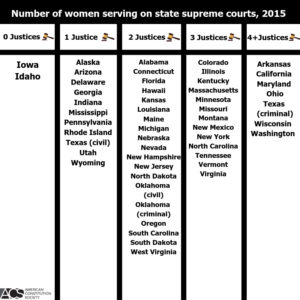
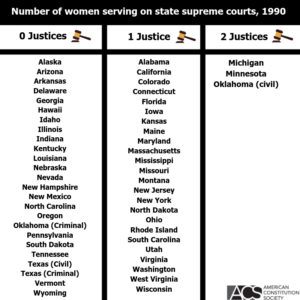
To test this theory, we examined the opinion-writing process on state supreme courts from 1990-2015.  We collected data on all state supreme court opinions from this time period in three issue areas: employment discrimination, environmental law, and search and seizure, resulting in a dataset 6,854 written opinions. This time period allows us to capture a period of great change for state supreme courts, when the prominence of women justices and chief justices increased, as shown in the tables below. In 40 of the 50 states, a woman has served as the chief justice on the court at some point during this 16-year period.

Although progress toward gender equality on state appellate courts has been considerable over the past 30 years, it remains incomplete. The Gavel Gap, a 2014 study of state court judicial diversity sponsored by the American Constitution Society found that two-thirds of state court appellate judges are men.

How Women Judges Shape Appellate Court Judicial Decision-Making

Examining state supreme courts allows researchers to take advantage of this variance in the number of women on the court, whether there is a woman chief justice, and if there was a woman majority opinion writer. Most notably, when the majority opinion author is a woman in cases involving employment discrimination or search and seizure, the predicted size of the majority coalition increases. The effect is strongest in employment discrimination cases, where having a woman write the majority opinion increases the percentage of justices joining the coalition by about 5%. In other words, women majority opinion writers can engender larger coalitions.  This is in line with our theory and what others have found about the consensus-building abilities of women judges and justices.

Surprisingly, we also found that when there are more women participating in the opinion writing process, the size of the coalition decreases in employment discrimination cases. For these cases, the results show that moving from a court with no women to a court of all women would decrease the size of the coalition by 21%, or about two justices on a seven-justice court. This result was contrary to our expectations, so we explored it further. What we found was that this result only held when the majority opinion author was male. In other words, in cases where women justices are more likely to have lived experiences (like experiencing discrimination in the workplace), when men write the opinion there is more disagreement among the justices. We cannot say for certain what is happening to cause this, but it is possible that women justices may have a harder time being heard during the opinion-writing stage by their male colleagues.

We did not find any significant gender effects in the likelihood that a case will be decidedly unanimously.  Neither the number of women justices, nor a woman serving as chief justice or as the majority opinion author, appears to influence whether a decision will be unanimous.

Of course, the importance of gender diversity in the judiciary is not limited to the perceived differences in decision-making between women and men.  There is value to having a diverse judiciary, not least because institutions that are open to all and reflect the population are essential to a representative democracy.

As the number of women serving in state and federal courts continues to increase, we must not limit ourselves to the simplest explanations of their influence.  We began our research in search of subtler differences in leadership that may influence the way opinions are written and our results remind us that truly understanding gender and judging is anything but simple.

In the Supreme Court: Deference to Agency Interpretations of Their Own Rules

On March 27, 2019, the Supreme Court will hear arguments in the case of Kisor v. Wilkie. James Kisor served in the Marines in Vietnam from 1962 to 1966. In 1982, he filed for disability benefits for post-traumatic stress disorder. The Veteran’s Administration denied his claim the following year because he had not been diagnosed with PTSD at the time. He did not appeal.

Fast forward to June 5, 2006, when Kisor asked to reopen his claim, attaching a PTSD diagnosis and some of his service records that had not been in his VA claims file previously. This time, the VA granted his request, but made it effective June 5, 2006. When he asked for an earlier effective date to obtain retroactive benefits, the VA declined.

The Board of Veterans Appeals agreed. The VA regulations require it to reconsider a claim “if VA receives or associates with the claims file relevant official service department records that existed and had not been associated with the claims file when VA first decided the claim.” The Board acknowledged that Kisor had submitted records that had not been associated with his claims file earlier, but found that the records were not “relevant” because they did not change the critical fact that he had not been diagnosed with PTSD in 1983. The U.S. Court of Appeals for Veterans Claims affirmed.

The U.S. Court of Appeals for the Federal Circuit also affirmed. In that court, Kisor argued for the first time that the VA had misinterpreted the term “relevant.” Evidence is relevant, he argued, if it has “any tendency to make the existence of any fact that is of consequence to the determination of the action more probable or less probable than it would be without the evidence.” The VA argued that evidence is irrelevant if it would not have mattered given other evidence. The records Kisor offered were not relevant, according to the VA, because they addressed an issue that was not contested: the fact that Kisor experienced an “in-service stressor” in Operation Harvest Moon. The Court of Appeals held that the term “relevant” is ambiguous in this context. Rather than deciding which party’s interpretation was better, the court followed Supreme Court precedent requiring deference to agency interpretations of their own regulations and held for the VA.

The problem is that those precedents have been under attack. In Bowles v. Seminole Rock in 1945, the Supreme Court held that an agency’s interpretation of its own regulations is controlling “unless it is plainly erroneous or inconsistent with the regulation.” Justice Scalia writing for the Court reiterated that holding in 1997, in Auer v. Robbins. Yet, by 2011, Justice Scalia had begun to wonder if it is “contrary to fundamental principles of separation of powers to permit the person who promulgates a law to interpret it as well.” Two years later, he had made up his mind that Seminole Rock is unconstitutional. Justice Thomas agreed, and Chief Justice Roberts, joined by Justice Alito, expressly invited petitions to reconsider it. Justice Gorsuch has expressed skepticism about it, and as Professor Chris Walker pointed out, Justice Kavanaugh likely would “be receptive to calls to eliminate — or at least further limit” Seminole Rock.

In Kisor’s petition for certiorari, he raised two questions. First, he asked whether Seminole Rock should be overruled. Second, he asked in the alternative whether Seminole Rock should yield to the substantive canon of construction that ambiguity should be resolved in favor of the veteran. The Solicitor General suggested that the Court address the question of whether the VA’s interpretation was correct. But the Court decided to address only the question of whether Seminole Rock should be overruled.

Professor Gillian Metzger pointed out, however, that Kisor’s case is not a good vehicle for overturning Seminole Rock because the VA’s interpretation came in a formal adjudication. The Court has long accepted that agencies have the discretion to make policy through either rulemaking or adjudication. Holding for Kisor here effectively could force the VA to engage in rulemaking to clarify the meaning of “relevant” in its regulations. Broadly applied, such a ruling could hamstring agencies significantly. But the Court doesn’t seem poised to overturn that well-established doctrine in this case.

So what’s the Court up to here? Metzger suggests that the cert grant in Kisor may be “best understood as part of a growing constitutional attack on administrative governance evident in Roberts Court jurisprudence.” Perhaps the Court will transfer the agency’s power to the judiciary by substituting its own statutory interpretation for that of the VA. This case could be a step along the way to invalidating the Chevron doctrine, under which courts defer to agency interpretations of the statutes they administer. Or perhaps Justice Kagan again will pull together a centrist majority to forestall disaster. Time will tell.

Declaring a Climate Change Emergency: A Citizen’s Guide

This blog was originally posted on Legal Planet

Would it be legal to declare a national emergency for climate change? Would it be useful? Here’s what you need to know.

The possibility of declaring a national emergency to address climate change will probably remain under discussion for the next couple of years, particularly if the courts uphold Trump’s “wall” emergency.  For that reason, I thought it might be helpful to pull together the series of blog posts I’ve written on the subject.  I want to emphasize three key points at the beginning:

  1. Declaring a climate emergency should be off the table if the Supreme Court rules against Trump.
  2. An emergency declaration is not a magic wand that gives Presidents a blank check. A Declaration would allow some constructive steps to be taken, but within limits.
  3. The ultimate goal has to be congressional action, and an emergency declaration should only be considered as part of a larger legislative and administrative agenda.

Even if the Court upholds Trump, using this precedent to fight climate change will require some real soul-searching. Trump has violated a long-standing norm of presidential restraint in using emergency powers to address domestic policy. Whether to disavow or exploit that change in norms is a hard question. And declaring a climate emergency might help mobilize public opinion in support of legislative action, or it might cause a backlash that would make new legislation harder. But if the Supreme Court rules for Trump, the idea of a climate change emergency declaration has to be taken seriously.

Something of a compromise position might be to declare that the resilience of the electrical grid is a national emergency, not climate change itself.  That would still allow some important actions that would help reduce carbon emissions. Basically, many of the steps that are needed to decarbonize the grid would also increase its ability to resist and bounce back from disruptions due to national disasters or cyberattacks on the energy system.

With all that in mind, here’s what you need to know about the issues.

Would Climate Change Qualify as a National Emergency?

Trump has declared a national emergency so he can build his wall. But if illegal border crossings are a national emergency, then there’s a strong case for viewing climate change in similar terms. That point has been made by observers ranging from Marco Rubio to a Legal Planet post by Jonathan Zasloff.

I agree but I want to dig deeper because it’s such an important point. In order to uphold Trump’s emergency declaration, the Supreme Court will have to either rule that the definition of emergency is exceedingly broad or that courts have little or no power to scrutinize a presidential declaration. There is a genuine legal basis for calling climate change a national emergency, as opposed to Trump’s ridiculous border-security declaration.

If it upholds Trump’s declaration, it would be extremely hard for the Supreme Court to overturn a climate change declaration.  One reason is that some attributes of climate change and immigration are similar. Both issues involve the country’s relations with the outside world, an area where presidential powers are strong.  But it isn’t as if we suddenly found out about border crossings or climate change. Given these similarities, it would be very difficult for the conservative majority to explain why it was deferring to the President in one case but not the other.

The only major difference actually cuts strongly in favor of an emergency declaration for climate change: The U.S. government has already classified climate change as a serious threat to national security, and it is a threat that is getting stronger daily. Recent science indicates that climate action is even more urgent than we thought.

Trump’s stated justification in his proclamation is that “the problem of large-scale unlawful migration through the southern border is long-standing, and despite the executive branch’s exercise of existing statutory authorities, the situation has worsened in certain respects in recent years.” Trump’s stated justification in his proclamation is that “the problem of large-scale unlawful migration through the southern border is long-standing, and despite the executive branch’s exercise of existing statutory authorities, the situation has worsened in certain respects in recent years.” Climate change, too, is a “longstanding problem,” and it certainly has gotten worse despite the effort of the executive branch (Obama) to address the problem. Federal agencies, as well as Congress, have made it clear that climate is a serious threat to our nation.

The Environmental Protection Agency. EPA has made a formal finding, based on an exhaustive review of the scientific evidence, that greenhouse gases endanger human life and welfare both within the United States and globally. That finding was upheld by the D.C. Circuit.  The Supreme Court reviewed other aspects of the D.C. Circuit’s decision but pointedly turned down requests that it review this EPA finding. The scientific evidence is ironclad. If a foreign power had somehow invented a weather-control technique to impose these harms on the United States, no one would doubt that this was a very serious national security problem. Trump is now trying to defuse this argument by convening a presidential commission, but the make-up of the commission will deprive it of any credibility.

Intelligence agencies.  National security agencies have consistently viewed climate change as a serious threat.  In written testimony to Congress about threats to national security, the Trump Administration’s own Director of National Intelligence (DNI) discussed climate change.  His discussion didn’t equivocate about the reality or dangers of climate change.  Rather, he took the science, and the threat, seriously: “The past 115 years have been the warmest period in the history of modern civilization, and the past few years have been the warmest years on record. Extreme weather events in a warmer world have the potential for greater impacts and can compound with other drivers to raise the risk of humanitarian disasters, conflict, water and food shortages, population migration, labor shortfalls, price shocks, and power outages. Research has not identified indicators of tipping points in climate-linked earth systems, suggesting a possibility of abrupt climate change.”

The Pentagon. The military has also taken a proactive stance on climate change. Former Secretary Mattis was clear about the impact of climate change on national security: “Climate change is impacting stability in areas of the world where our troops are operating today. . . It is appropriate for the Combatant Commands to incorporate drivers of instability that impact the security environment in their areas into their planning.”

Congress. Congress has also recognized climate change as a threat to national security and more specifically to military infrastructure and activities.  The most significant action was the passage of the Defense Authorization Act of 2017, HR 1810. The Act was a funding statute for the Pentagon.  Section 335 of the Act states that “climate change is a direct threat to the national security of the United States and is impacting stability in areas of the world both where the United States Armed Forces are operating today, and where strategic implications for future conflict exist.” In a crucial House vote, 46 Republicans crossed the aisle to vote against an effort to take out the climate provision. President Trump signed the bill.

This is not the place to delve into issues that will be posed in legal challenges to Trump’s order nor into the wisdom of declaring climate change a national emergency.  But if the Supreme Court does uphold Trump’s order, it will be very difficult indeed to overturn a Presidential declaration that climate change is a national emergency.

What Legal Authority Would an Emergency Climate Declaration Give the President?

What government powers would be unlocked by declaring a climate change emergency? One immediate possibility would be to use the same power that Trump is considering in order to divert military construction funds to other uses – in this case, perhaps building wind or solar farms or new transmission lines. But what else could President X do?

The Brennan Center has compiled a helpful list of almost 150 statutes giving the President special powers during emergencies. The list doesn’t map the outer perimeter of presidential powers – there are other laws that give Presidents powers to take action on the basis of national security, and the President also has some ill-defined, though not unlimited, powers to take action without explicit congressional authorization. But the list provides a good start.   Since this issue has come up so recently, I can’t claim to have researched the statutes on the list in any depth, but my “prospecting” effort was enough to identify some promising areas for further exploration.

Here are some of the possibilities:

  • Oil leases are required to have clauses allowing them to be suspended during national emergencies. (43 USC 1341) If climate change is a national emergency caused by fossil fuels, then suspension seems like a logical response.
  • The President has emergency powers to respond to industrial shortfalls in national emergencies. (50 USC 4533). This could be used to support expansion of battery or electrical vehicle production. Another provision allows the President to extend loan guarantees to critical industries during national emergencies. (50 USC 4531). This could be used to support renewable energy more generally.
  • The Secretary of Transportation has broad power to “coordinate transportation” during national emergencies. (49 U.S.C 114). This might allow various restrictions on automobile and truck use to decrease emissions of greenhouse gases.
  • The President may invoke the International Emergency Economic Powers Act to deal with “any unusual and extraordinary threat, which has its source in whole or substantial part outside the United States.” (50 USC 1701-1707).That description certainly applies to climate change. According to the Brennan Center, this Act “confers broad authority to regulate financial and other commercial transactions involving designated entities, including the power to impose sanctions on individuals and countries.” Conceivably, these powers could be deployed against companies or countries trafficking in fossil fuels.

There may well be others on the Brennan Center list that I missed.  Moreover, as I said above, the President has other powers relating to national security, statutory and otherwise, that aren’t keyed to a declaration of national emergency – for instance, the kinds of tariffs Trump has imposed on foreign goods (say those relating to oil and gas drilling, or to oil imports.)

You might well respond that using these various powers to deal with climate change is stretching them far beyond any reasonable understanding of congressional intent. But if the courts upholds Trump’s action, that will be a sign that they’re not willing to apply any meaningful oversight to presidential actions.

What Would be the Possible Benefits of an Emergency Declaration?

declaring a climate emergency could have benefits even apart from any concrete follow-up.  It would be a strong signal that the U.S. recognizes the urgent need to cut carbon emissions – a signal to the international community as well as courts and agencies in the U.S.  That would be a plus by itself.

Beyond that, I would favor tying emergency actions (at least at the start) to recognized issues that impact our society’s security.  One is grid resilience. Renewables and storage would make a particular contribution to resilience in areas where they have the least penetration, meaning the Southeast, but also in many other states.  Microgrids combined with distributed solar could also be useful in the wake of natural disasters like the hurricanes endemic to the Gulf Coast.  We need to jump-start the carbon transition in those parts of the country to pave the way for more comprehensive measures. We also need to upgrade the grid elsewhere.  Doing so would allow much bigger cuts in emissions from the electricity sector.

Another security-related issue involves military installations.  The military has already taken steps to increase use of renewables and to harden sites against sea level rise.  But a lot more could be done, particularly in the way of much greater electrical storage capacity (which might include use of electric vehicle batteries).  Military funds could be redirected for these purposes, and the military could also be involved in increasing grid resilience in areas surrounding military bases and for critical infrastructure more generally.   This could be especially helpful in starting the ball rolling in the Southeast, which remains the most backward area in terms of renewable energy.

A third option would be to take America out of the business of encouraging the use of coal in other countries.  Emergency and national security powers give the President considerable leverage over exports and financing of foreign projects. We should not be devoting our resources or production to encouraging countries like India to build more coal plants.

It would take a lot more work to turn these ideas into actionable proposals.  We’d need to know the effect of these measures, the available resources, and just what statutory provisions would support them. Closer study could also turn up additional possibilities.   It would probably take a sustained effort, maybe by a small team, to actually work through the issues in-depth.

* * * *

If the Supreme Court overturns Trump’s order, declaring a climate emergency seems far less appealing. But who knows if that will happen? And of course, we have no way of knowing just when we might have a President who actually wants to do something about climate change. That’s definitely not something we should take for granted! But if and when that does happen, he or she should have access to a full analysis of the policy options.

As much as I care about climate change, I am hoping that the courts reject Trump’s emergency declaration, which would make these questions moot. Even putting aside my feelings about the wall itself, I think it’s an undesirable expansion in presidential power.  But there’s no guarantee the courts will stop Trump. If his action is upheld, the door will be open for declaring a climate emergency, if we choose to go down that path.