



April 11, 2012
Private: What AG Holder Could Have Said to Fifth Cir. Judge Jerry Smith
Affordable Care Act, Attorney General Eric Holder, Health Care Reform, Judge Jerry Smith, U.S. Court of Appeals for Fifth Circuit
by Nicole Flatow
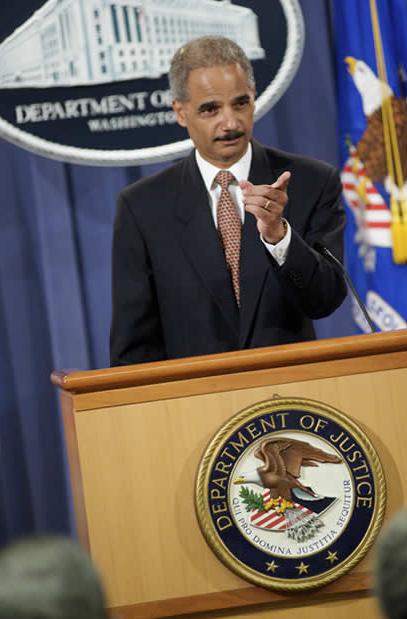
When Fifth Circuit Judge Jerry Smith asked the Department of Justice for a three-page single-spaced memo defending its support for the long-established principle of judicial review, Attorney General Eric Holder did what was asked and responded.
He refrained from pointing out, as Jeffrey Toobin did, that Smith’s behavior during the hearing on a challenge to the Affordable Care Act was a “disgrace,” or as Orin Kerr did, that it was “highly inappropriate” for Smith to ask the DOJ to defend political comments by President Obama about the Supreme Court’s review of the health care law totally outside of the scope of the record in the case.
But in his dreams [and in The American Prospect], constitutional law professor Garrett Epps envisions a different kind of letter Holder might have sent, in which he refuses to respond on the basis that the Fifth Circuit has absolutely no jurisdiction in this case over the President of the United States:
Dear Judge Smith,
… This letter is a truthful response to this court's order and the issues of jurisdiction and judicial ethics it raised. Because it is truthful, it will never be filed with any court. Nonetheless, I will take this imaginary opportunity to state that the proper response to your order is a regretful refusal to comply on the grounds that it was made in excess of your jurisdiction, that it raises serious issues about your fitness to serve the United States in a position of honor and trust, and that it tends to bring discredit on the federal judiciary.
Epps goes on to explain that the very same decision that established judicial review, Marbury v. Madison, also established that “federal courts are courts of limited jurisdiction” and any attempt to go outside that jurisdiction deprives them of their power.
While presidents are political actors who have criticized the courts since Thomas Jefferson, judges are expected not to act as naked partisans, he explains.
He continues:
You can be forgiven for having forgotten your proper sphere in the constitutional system. You've had a lot of bad examples. Two Justices of the Supreme Court, Justice Clarence Thomas and Justice Antonin Scalia, have openly associated themselves with the President's political enemies. In the recent health-care oral argument, Justice Scalia played by turns the roles of bully and buffoon. Judge Roger Vinson's District Court opinion in the Health Care Cases read like a transcript of a far-right talk-radio show. Judge Henry Hudson of the Eastern District of Virginia heard a challenge to the ACA even though a partisan political consulting firm of which he is part owner had a business relationship with the politician bringing the case. Chief Judge Richard Cebull of the District of Idaho sent out an openly racist email disparaging both President Obama and, remarkably, his mother. He “apologized” by explaining that he had only used racist language because he is “not a fan” of the President: “I didn't send it as racist, although that's what it is. I sent it out because it's anti-Obama.” In the judge’s mind, the intent to show disrespect to the President was acceptable.
Not since the Sedition Act Crisis of 1798 has any segment of the federal judiciary come to occupy a position so clearly defined by unprincipled, lawless allegiance to one political party and open, personalized hostility to the other. Certainly the “activist” courts your political patron criticized never, even in the cases they arguably got wrong, personalized them as a quarrel with the President of the United States.
In sum, Judge Smith, it would be improper for this office to grovel before you. To be a federal judge is a great honor. A judge who responds to the honor by transgressing the limits on his jurisdiction or his role is no longer a judge; he is a thug with a hammer.
Not signed,
Eric Holder
Constitutional Interpretation, Importance of the Courts, Judicial independence