



February 26, 2026
The Next Revolution in Constitutional Law
John A. and Elizabeth H. Sutro Professor of Law, Santa Clara University School of Law
The views expressed on the Expert Forum are those of the authors writing in their personal capacity. The views presented do not represent the American Constitution Society or its chapters.
In a recent essay in the New York Times, Jeffrey Toobin argued that “the liberal constitutional agenda is failing.” In his view, “progressives have done a lot better pointing out the weaknesses of originalism than coming up with alternatives.” Progressives, he says, know what they “stand against,” but do not have a clear answer about what they “stand for.”
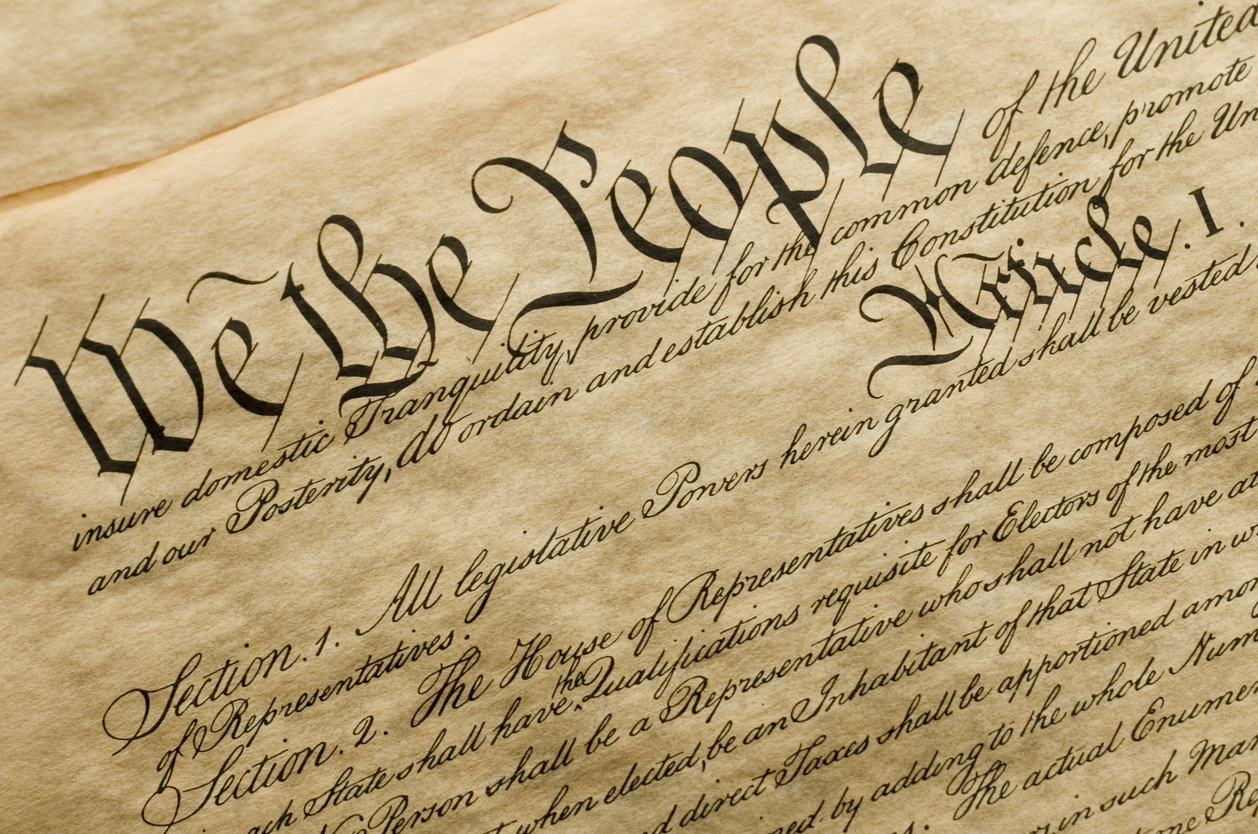
My recent book, People v. The Court: The Next Revolution in Constitutional Law, articulates a progressive theory of judicial review that answers Toobin’s call for an alternative to originalism. Current doctrine divides constitutional law into rights issues and structural issues. This dualistic framework obscures a central feature of the Constitution. Properly understood, the Constitution divides power between the government and We the People. It grants citizens an affirmative, collective right to maintain effective control over our government.
Viewed through the lens of the Court’s current constitutional doctrine, We the People are invisible. We do not appear in the Court’s structural constitutional doctrine because that body of law focuses exclusively on the division of power between and among government actors. We do not appear in the Court’s rights doctrines, because those doctrines focus exclusively on negative individual rights, not affirmative, collective rights. A future, progressive Supreme Court should exercise its power of judicial review to enforce the Constitution’s structural division of power between the government and We the People, and to enforce our affirmative, collective right to maintain effective control over our government.
People v. The Court unpacks this idea by building on John Hart Ely’s insight that aggressive judicial review “appropriately exists for those situations where representative government cannot be trusted, not those where we know it can.” This essay briefly explains how my theory and Ely’s insight apply in four different areas of constitutional doctrine: election law, individual rights, federalism, and separation of powers.
Election Law
Election law is an area where representative government cannot always be trusted, because elected politicians are often tempted to entrench their own power, rather than serving the public interest. Therefore, as Ely argued, the Supreme Court should engage in aggressive judicial review to correct malfunctions in the electoral process. Chief Justice Warren’s opinion in Reynolds v. Sims, which famously established the “one person, one vote” principle, provides an excellent example of this type of strong judicial review. Building on the Reynolds precedent, People v. The Court argues that a progressive Supreme Court should ban partisan gerrymandering and require those in charge of redistricting to draw boundaries in a way that maximizes the number of competitive seats for both state legislatures and the House of Representatives. These and similar rules are necessary to vindicate the affirmative, collective right of We the People to maintain effective control over our government.
Federalism
In contrast to election law, a progressive Supreme Court should practice deferential judicial review for all federalism cases in which litigants allege that Congress has violated state sovereignty or intruded into the reserved powers of the states. These are areas where we can trust our elected representatives in Congress to do the right thing. As Herbert Wechsler famously argued, the political safeguards of federalism are sufficient to protect the states from unwarranted congressional interference. The Constitution, properly understood, grants political actors the authority to make decisions about the proper distribution of legislative authority between Congress and state governments. When the Court engages in aggressive judicial review to invalidate federal legislation on the grounds that it allegedly violates federalism principles, the Court itself violates our affirmative, collective right to maintain control over our government by transferring decision-making authority from a government entity that is accountable to the people (Congress) to a government entity that is not accountable to anyone (the Supreme Court).
Respect for state autonomy is neither a liberal value nor a conservative value. For example, liberals favor state autonomy with respect to gun regulations, but in cases such as McDonald v. City of Chicago and New York State Rifle Ass’n v. Bruen, a conservative Court has intruded deeply into an area traditionally reserved to the states under the Tenth Amendment. More broadly, conservative Justices fail to recognize that the primary federal threat to state autonomy comes not from Congress, but from the Supreme Court. A progressive Supreme Court that is committed to federalism principles could enhance state autonomy by repudiating incorporation doctrine, a doctrine that has vastly expanded federal judicial power at the expense of the states. (I explain later in this essay how the Court can provide robust protection for individual rights without incorporation.) Granted, this is a radical proposal that is unlikely to be implemented in the near future. However, repudiation of incorporation doctrine would enhance state autonomy much more than any of the Court’s federalism decisions since United States v. Lopez (1995). Those decisions purport to protect state autonomy by limiting Congress’s legislative powers. In fact, the Court’s so-called “federalism” decisions have effectively transferred federal lawmaking power from our elected representatives in Congress to unelected, unaccountable Justices, but they have done very little to enhance state autonomy.
Presidential Power
A progressive Supreme Court should also practice deferential judicial review in most cases where litigants allege that Congress has violated the Constitution by infringing powers vested in the President. Let me be clear: the Constitution’s Vesting Clause, which vests the “executive power” in the President, does not impose any constitutional limit on Congress’s power to regulate the executive branch. To the contrary, the Necessary and Proper Clause expressly grants Congress the power to “make all laws which shall be necessary and proper for carrying into execution” the President’s executive power. Moreover, the Take Care Clause creates a constitutional duty for the President to “take care that the laws be faithfully executed.” To paraphrase Justice Scalia in Morrison v. Olson, that duty applies to all laws enacted by Congress, not just laws that the President likes. When the Court invalidates federal legislation on the grounds that it infringes powers reserved to the President under the Vesting Clause, the Court itself violates the affirmative, collective right of We the People to insist that all federal officers must comply with laws enacted by our elected representatives. If the Court allows the President to violate those laws, government “of the people, by the people, and for the people” becomes a government of one man, by one man, and for one man.
Trump v. Slaughter illustrates this point. Since its landmark 1935 decision in Humphrey’s Executor, the Court has repeatedly affirmed Congress’s power to impose statutory limits on the President’s unfettered discretion to fire federal officers. The Court will almost certainly decide Slaughter before the end of this term. Pundits expect that Slaughter will overrule Humphrey’s Executor and grant the President sweeping power to fire federal officers in violation of federal statutes. The Court’s decision will likely rely on the unitary executive theory—a theory embraced by self-proclaimed originalists that is based on a dangerous misunderstanding of the Constitution’s text, structure, and original public meaning.
By overruling Humphrey’s Executor, the Court will accelerate the rise of Presidential dictatorship, a form of government that is antithetical to the Constitution’s commitments to popular sovereignty and representative democracy. One of the first priorities for a future, progressive Supreme Court should be to repudiate the unitary executive theory and revive Humphrey’s Executor. It is not hyperbole to suggest that the continued survival of republican government in the United States depends on the Court’s willingness to reverse our ongoing descent into autocracy by enforcing federal statutes that constrain Presidential power.
Individual Rights
Finally, let me address the subject of individual rights, an area where my views differ markedly from what might be called “liberal orthodoxy.” People v. The Court advocates a system of weak judicial review to protect individual rights from government infringement. Weak judicial review differs from deferential review in that it does not involve judicial deference to Congress. Weak review differs from strong review because, in a system of weak review, judicial decisions protecting individual rights are subject to legislative override by Congress. The option of legislative override is essential to preserve our affirmative, collective right to maintain control over our government. With legislative override, elected legislators (and through them, American voters) get the final say over major public policy issues, such as gay marriage and abortion rights. Without the option of legislative override, unelected Justices get the final say, depriving American citizens of our affirmative, collective right to maintain effective control over our government.
Skeptics contend that a system of weak judicial review would erode protection for individual rights. However, Australia, Canada, New Zealand, and the United Kingdom all apply systems of weak review to protect individual rights. All four countries earn high scores on the V-Dem liberal democracy index and Freedom House’s Freedom in the World rankings, demonstrating that weak judicial review is fully compatible with strong protection for individual rights. Moreover, as I have demonstrated in prior scholarship, a system of weak review has strong roots in U.S. historical traditions. For much of the nineteenth century, federal courts applied a system of weak review to protect individual rights from infringement by government actors. In particular, they relied primarily on international law, not constitutional law, to protect individual rights from government infringement. Since Congress has the power under the later-in-time rule to override judicial decisions based on international law, judicial reliance on international law to protect individual rights preserved the option of legislative override.
Today, the United States is a party to both the International Covenant on Civil and Political Rights and the Convention Against Racial Discrimination, two major international human rights treaties. Taken together, those two treaties protect most of the rights that are currently protected under the Bill of Rights and the Fourteenth Amendment. Congress has the power to enact legislation authorizing judicial enforcement of those treaties. Such legislation could also encourage courts to apply the canon of constitutional avoidance to avoid constitutional decisions in cases where judicial enforcement of a human rights treaty could substitute for judicial enforcement of the Bill of Rights or the Fourteenth Amendment. If federal courts honored such legislation, the net result would be a system of weak judicial review in which courts provide robust protection for individual rights, but the American people maintain effective control over our government, because judicial decisions would be subject to legislative override by our elected representatives in Congress.
Under this approach, applying human rights treaties to the states via the Supremacy Clause would be functionally similar to applying the Bill of Rights to the states via incorporation doctrine. By repudiating incorporation doctrine and enforcing human rights treaties, the Court could ensure robust protection for fundamental human rights, while also respecting federalism principles by returning power to the states for that small set of incorporated rights that are not protected by human rights treaties. (Specifically, states would gain greater autonomy with respect to rights protected by the Establishment Clause, the Second Amendment, the exclusionary rule, the Sixth Amendment jury trial right, and the Eighth Amendment Excessive Fines Clause. As explained in People v. The Court, the Fifth Amendment Takings Clause would still apply to the states via incorporation doctrine.) All other incorporated rights would be protected by enforcing human rights treaties against the states via the Supremacy Clause.