



October 17, 2009
Private: Making the Case for an Education Amendment
Education Amendment, Lynn Huntley, No Time To Lose
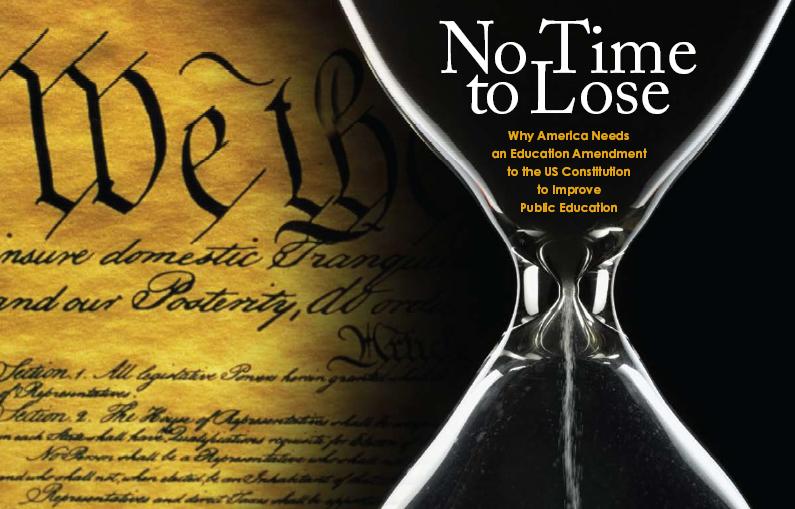
By Lynn Huntley, Esq., President, The Southern Education Foundation. Today's post is the final of a two-part series on the SEF's report, "No Time to Lose: Why America Needs an Education Amendment to the US Constitution To Improve Education." The first post is here.
Responses to the Problem
America needs an education amendment to the U.S. Constitution for a number of reasons.
First, it is needed because efforts in state or federal courts to reform public education finance and resource allocation are blunt instruments by which to effect change. Litigation costs a lot, cannot assure sought after outcomes, and cannot address fully the resource challenge. That is, if a case is brought in a low resource district or state, one cannot get "blood from a turnip" and secure funds adequate to effect transformation. In such circumstances, the law offers only the illusion, but not the reality of redress of grievances.
Second, years ago when I worked at the NAACP Legal Defense and Educational Fund, a lot of attention was directed toward trying to persuade members of the Supreme Court to "find" a cognizable right to an equal quality public education opportunity within the four corners of the text of the U.S. Constitution. Those hopes were dashed when the Supreme Court held in the Rodriguez case that no such right exists, even though the evidence before the court demonstrated gross differences in the amounts spent on the education of predominantly Mexican, as compared to Anglo, students by school district. Finding that "wealth" is not a suspect classification warranting the highest level of scrutiny in cases involving unequal public education finance, the Court, fearing a "slippery slope," found no equal protection violation nor implied substantive right to education under the U.S. Constitution. Cases that would have desegregated traditionally White schools and districts and afforded low income Black students a chance to receive the same education as more advantaged Whites by attending the same schools became increasingly unpopular and difficult to win in federal court. The federal judicial system has become a "dry socket" on issues of education equity.
Third, after Rodriguez, low income students or underfunded school districts fled from federal to state courts to challenge the failure of local districts or schools to comply with state constitutional standards of wildly variable content There have been over 49 lawsuits brought across America in state courts to challenge the inadequate and uneven levels of monies and resources provided in diverse schools and school districts.
These cases have made a significant difference in advancing education improvements in some places. But in others, state courts have held that a very low standard of public education adequacy is all that is required and few significant changes have resulted. Moreover, as noted above, even in cases where the outcome has been favorable to the plaintiffs' claims for more resources and monies for public education, legislatures are often been dilatory or frustrate judicial mandates.
The Case for An Education Amendment to the U.S. Constitution
Is the problem of resource and funding inequity in public education to remain a insurmountable barrier to providing all children an opportunity to learn? Wouldn't it be ironic if after all of the effort that went into Brown v. Board of Education, it were to turn out that the same vulnerable minority group-African Americans and other such groups disproportionately mired in poverty-could find no meaningful relief from a dual class, race or place based systems of state operated public education opportunity allocation?
I think that there should be an education amendment to the U.S. Constitution enacted to require the federal government to ensure that state and local governments have the resources and monies necessary to provide all students with a quality opportunity to learn. That is the surest way of addressing the problem of radical disparities in education finance and resourcing now and for the benefit of future generations.
I do not put forward the idea of some form of education amendment to the U.S. Constitution lightly. I am well aware of the high bar to be cleared before the language of the highest law in the land is changed in any material way. But I believe that education is so important to national well being and security and the problem of unfairness and inadequacy of public education finance is so profound that the US Constitution must become a vehicle of relief and redress.
In the report, "No Time to Lose, Why America Needs an Education Amendment to Improve Public Education," my Southern Education Foundation (SEF) colleague, Steve Suitts, and I lay out in broad brush strokes the "case" for an education amendment. The report is downloadable without cost on SEF's Web site.
The report does not purport to prescribe specific language of an education amendment to the US Constitution nor marshal all of the appropriate and requisite scholarship. Its purpose is simply to introduce an idea, a possibility whose time has come, to a broad and diverse audience for consideration. The aim is to spark fresh consideration of the age-old problem of affording low income people second-class quality public education.
The report basically argues that:
- State and local governments can't and won't solve the problems of intrastate and interstate disparities in public education quality alone. They need to be mandated to effect changes in the area of finance and resourcing of public education and they need federal money to achieve results.
- There is nothing sacrosanct about the current decentralized system of public education resource and financing. If the nation were developing plans for a public education system today, who would believe that vesting close to 14,000 school districts in 50 states with authority over public education is the best way to proceed? Clearly new partnerships, arrangements and structures are needed, not to wholly exclude state and local governments from engagement in public education provision, but to re-calibrate such relationships, re-envision and harmonize roles.
- Unless unequal, inadequate public education finance and resourcing is to be the problem without a remedy, something big and dramatic has to occur to focus national attention and public will on the imperative to improve public education quality, resources and finance. The structures of responsibility for funding and resource standards need to be streamlined and reconstituted nationwide, from the bottom up and top down.
- A policy and structural shift of the type required to make equity in public education a reality for all students requires a major public debate in all quarters and at all levels. An effort to amend the US Constitution to address such issues will spark fresh and new public attention and debate about the nature of the problem to be solved and national values related to fairness and education. It will also create "space" for intermediate steps in the right direction.
- Education is more important to the national interest, economically, socially, politically and in terms of national security than ever before. Codifying the national commitment to public education provision in the US Constitution is the best way to create a permanent framework for the allocation of power and resources in this area so critical to national well-being.
- Education is the best antidote to poverty that we've got. To preserve the hopeful and democratic nature of American society through maintenance of ladders of upward mobility for all through education is a core value that ought to be affirmed in the highest law in the land.
- In the increasingly diverse population of the nation, there is a need for public education systems, especially as they serve the poor, that can harmonize differences and make "e pluribus unum." Education is the great equalizer to quote Horace Mann.
- Stop gap and piecemeal legislation will always be necessary but not sufficient. A broad constitutional mandate requiring the federal government to ensure adequate resources for equitable public education will require implementing legislation. By putting education in the US Constitution, the nation would be attaching priority to this area that is often trumped by other issues at the budget negotiating table.
- Even if unsuccessful, an education amendment effort would inform the public about the nature of education inequity and affect mores and policies, in the same way that the failed Equal Rights Amendment effort nevertheless changed public perceptions of and practices in relation to gender.
Conclusion
At present, many policymakers don't fathom that the key to economic competitiveness is to have an excellently educated populace and work force. They are living in a by-gone era when low skilled jobs still paid livable wages and haven't adjusted to present realities. Policymakers often prefer the path of least resistance and don't want to raise taxes or reallocate resources because to do so would not be popular. This is so especially since a majority of Americans have no children in school and don't see why they should have to pay increased taxes to pay to educate "other people's children." For some members of the public, it is counterintuitive to believe that investment in people who were excluded or marginalized when American became a superpower can add real value to the economy and need to have a quality education.
The current recession and economic fragility make it difficult to muster at any level of government increased resources to improve education for low income students. Even the much heralded federal commitment to improving education for the "least of these" advanced by the Obama administration will likely be unsustainable. Moreover, most of the monies received thus far by states have gone toward "holding the line" against further cuts in public education quality, not focused efforts to improve education of low income students.
Nobel Prize Laureate Fridtjof Nanses (Peace, 1922) said: "The difficult is what takes a little time; the impossible is what takes a little longer." It is SEF's hope that its report will begin the long journey toward fundamental structural reform in public education. It is our hope that the report will prompt an earnest debate among people who care about the nation about what can and must be done to help low income students have better chances in life through education.
My brother often says, when I criticize his children and implore him to do something, "If you think you can do better, be my guest." I say that earnestly to all who care about the future of the nation and public education. If you don't like or support the idea of an education amendment or even having a public debate about what might be wrought by an education amendment to the U.S. Constitution, what would you do to eliminate radical disparities in public education funding and resourcing, intrastate and interstate?
We need all big minds and hearts engaged in the search for constructive solutions. The greatest failing is indifference to the problem.