



July 6, 2011
Private: Justice Sotomayor Providing Progressives Reason for Hope, GW Prof. Fontana Writes
Justice Sonia Sotomayor, Professor David Fontana
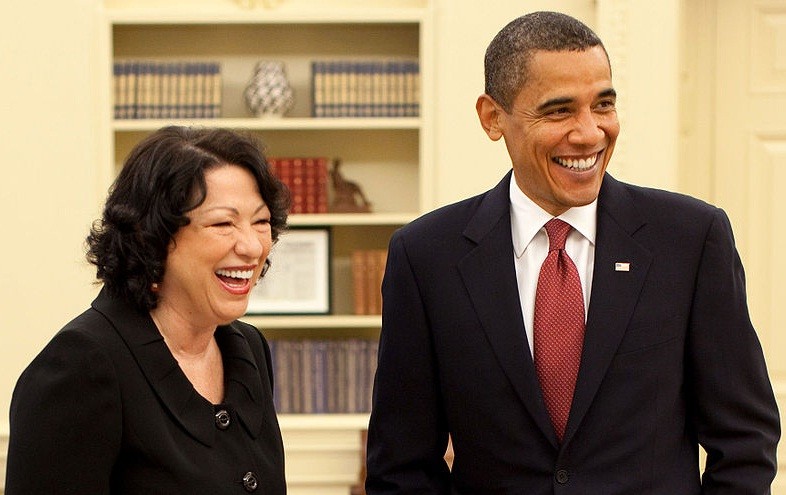
Nearly two years after she joined the Supreme Court, Justice Sonia Sotomayor is developing a unique voice that should provide some uplifting news for progressives, George Washington University law school professor David Fontana writes in a piece for The New Republic.
Fontana noting that “many” progressives were left unmoved by Sotomayor’s testimony at her confirmation hearings, says things look different now. Commentary from the Los Angeles Times, The New York Times and Slate about her work on the court, typically supportive of the court’s progressive bloc, is noteworthy, but, Fontana writes, it is the justice’s actions away from the bench that is proving the most consequential.
“Sotomayor,” he writes, “has become the public face of the Court’s liberal wing because she seems to be what so few justices are: a real person, with jurisprudence to match.”
While other justices, such as Antontin Scalia and Stephen Breyer are busy plumping for their books on legal theories to primarily academic audiences, or Justice Clarence Thomas is cozying up to the Koch brothers, Sotomayor has spoken to diverse audiences on an array of issues, including some personal ones. She is also working on a book that her publisher, Fontana notes, “is a coming-of-age memoir by an American daughter of Puerto Rican immigrants.”
Sotomayor, Fontana continues, has “shared her perspective about persistent barriers to equality with audiences at several elite law schools and with a community college in the Bronx that helped her mother become a nurse several decades ago.”
Moreover Sotomayor (pictured with President Obama) has also used public appearances to highlight “the ways in which our legal system still reflects biases against various historically disadvantaged groups,” Fontana writes.
He adds, “In a public interview during a visit to Northwestern Law School, Sotomayor said some of the questions she faced during her confirmation hearings were symptomatic of lingering gender bias. And, at the University of Chicago Law School, she said, “People have views of me and expectations of me that are based on stereotypes.” She also said some of Chief Justice Roberts’s views on race and the law are “too simplistic.”
Fontana’s entire article is available here.
[image via White House Photostream]
