



September 27, 2010
Private: The Future of Criminal Justice: Constitution in 2020 Bloggers
The Constitution in 2020: The Future of Criminal Justice
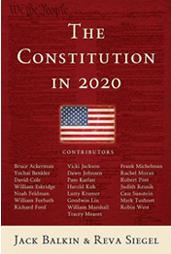
At Balkinization, scheduled panelists for the forthcoming symposium at Florida State University College of law, "The Constitution in 2020: The Future of Criminal Justice," are providing guest posts on some of the material they will explore at the Oct. 7-8 event.
Christopher Slobogin, law professor and director of the Criminal Justice Program at Vanderbilt University Law School, is scheduled to take part in a Friday, Oct. 8 panel called, "National Security and Liberty."
In a post for Balkinization, Slobogin writes that the Supreme Court's interpretation of the Fourth Amendment has centered almost exclusively on physical searches, such as "entry into a house or car, a stop and frisk of a person on the street, or rifling through a person's private papers. But today, with the introduction of devices that can see through walls and clothes, monitor public thoroughfares twenty-four hours a day, and access millions of records in seconds, police are relying much more heavily on what might be called ‘virtual searches,' investigative techniques that do not require physical access to premises, people, papers or effects and that can often be carried out covertly from far away."
He continues, "Most importantly, the Court's case law has made clear that, outside of interceptions of communications content, a Fourth Amendment ‘search' usually occurs only when there is a physical intrusion of some sort into the suspect's property. That means that as a constitutional matter neither a warrant nor any level of suspicion is needed to justify most virtual searches."
Scheduled to participate in the panel, "Crime Control and Equality," University of California, Berkeley law school professor David Sklansky, asks in his guest post, "What should constitutional regulation of police look like in 2020?" Sklansky notes that "modern constitutional criminal procedure" can be traced to the Warren Court and that "lessons for constitutional criminal procedure are several."
Sklansky writes:
First, issues of race in policing remain fraught and pressing. We could use a renewed commitment to that part of the Warren Court's criminal procedure agenda. Second, though, there's been enough progress, on that front and others, to make inequality in the provision of policing increasing important. It's a more and more glaring failure of our constitutional discourse that we lack even the most rudimentary idea of a right, judicially enforceable or not, to minimally adequate protection against private violence. Third, we need ways to think about and to address the blurred boundaries between law enforcement on the one hand and, on the other hand, the growing range of other agencies and governmental functions that pool their resources and their legal powers with the police. That is a large challenge and, unfortunately, one for which existing doctrine offers little help.
L. Song Richardson, professor of law and co-director of the Center for Law and Science at DePaul College of Law, and scheduled participant for the "Crime Control and Equality," panel, writes for Balkinization that she envisions "a future in which courts acknowledge and take into consideration the complexity of race and its effects on police behavior rather than denying its influence or dividing the police into conscious bigots on the one hand and non-racists on the other. In order to realize this vision, courts must broaden their conception of Fourth Amendment reasonableness to include consideration of the effects of implicit (unconscious) racial biases on police behavior.
...
Richardson asks, "Why do officers continue to stop and frisk non-Whites at higher rates than Whites when stops and searches of Whites are often more successful in yielding evidence of criminal activity? One common explanation is bigotry. Another is that the police act rationally when they profile Blacks because Blacks commit more crimes. While these explanations may have some merit, I find both unsatisfying because they overlook the effects of implicit biases on police behavior that can also explain these results."
Also set to participate in the Oct. 8 "Crime Control and Equality," panel, Darryl Brown, a law professor of the University of Virginia School of Law, writes in a guest post for Balkinization that despite Supreme Court decisions that have concluded that states have a constitutional obligation to provide indigent criminal defendants with legal representation, is the inconsistency of states to do live up to those obligations.
Brown writes:
The problem with Gideon's [the high court's 1963 landmark opinion, Gideon v. Wainwright] guarantee of counsel is that it is an unfunded mandate to state governments (who often delegate the duty to local governments). Courts are loathe to regulate state funding decisions, and yet states are politically loathe to fund indigent defense sufficiently. The problem with Strickland's guarantee of adequate representation is that it is designed only as a post-conviction, hindsight assessment of counsel's performance. In that form, it is deliberately deferential both because of the difficulty of retrospectively assessing a lawyer's performance and the sunk costs of a completed adjudication process.
The Constitution in 2020: The Future of Criminal Justice is hosted by the Florida State University College of Law and ACS. The program as noted on Balkinization "is one of a series of academic events connected to the Constitution in 2020 project." The event's entire schedule is here. Additional panelists will blog for Balkinization in the days to come; check back here for links to those guest posts.
Constitutional Interpretation, Criminal Justice, Search and Seizure, Supreme Court