



January 29, 2010
Private: Fair Pay One Year Later
Employment Law, Lilly Ledbetter Fair Pay Act, Paycheck Fairness Act
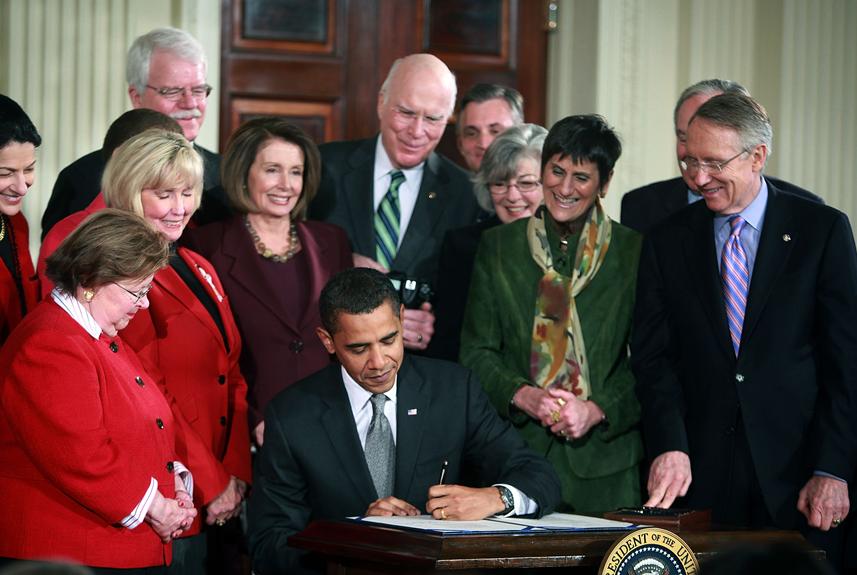
By Fatima Goss Graves, Vice President for Education and Employment, and Kavitha Sivashanker, Fellow, National Women's Law Center
A year ago today, President Obama signed the Lilly Ledbetter Fair Pay Act of 2009 (pictured left). The law overturned the disastrous Supreme Court decision in Ledbetter v. Goodyear Tire & Rubber Co.
The Act explicitly provides that "an unlawful employment practice occurs ... when a discriminatory compensation decision or other practice is adopted, when an individual becomes subject to a discriminatory compensation decision or other practice, or when an individual is affected by application of a discriminatory compensation decision or other practice, including each time wages, benefits, or other compensation is paid" as a result of such a practice.
In the past year, courts around the country have implemented the Act as Congress intended for straightforward pay discrimination cases. In cases involving pay discrimination based on sex, race, disability, and age, these courts have recognized that the statute of limitations is renewed with each paycheck marred by discrimination.
But not every plaintiff has had their pay discrimination case restored by the Act, and there are a few thorny implementation issues that have emerged which courts will continue to flesh out. So where do we currently stand with the Ledbetter Act? One year later, our assessment is that while the Ledbetter Act was a true, hard-won victory for women and families, it is only the first step towards addressing pay disparities for women.
What are some of the issues on the table? Well, to name just a few:
1. One question still to be worked out by the courts is whether and how the Act is retroactive. Congress made clear that courts must treat the Supreme Court's decision in Ledbetter as if it had never been issued, and pay discrimination plaintiffs should have their claims restored. Thus, plaintiffs who continue to receive discriminatory paychecks (even if initial acts of discrimination occurred prior to the Act) have had their claims reinstated, as well as plaintiffs whose claims were pending at the time of the Act either in court or at the EEOC. In Hester v. N. Ala. Ctr. for Educ., for instance, the Eleventh Circuit agreed that the plaintiff's Title VII claim that she was paid less than male employees engaged in substantially equal work should be restored in light of the Ledbetter Act. However, it remains to be seen what limits courts will place on the Act's retroactivity. For example, courts have not yet had the opportunity to consider the more complex issue of cases involving claims not pending when the Act came down, because plaintiffs decided not to appeal claims or decided not to bring their claims at all due to the Supreme Court's decision in Ledbetter.
2. Another unresolved issue is whether the Ledbetter Act overturns the Ledbetter decision's application outside of the employment context, and the express statutes identified by Congress in the Act. Before the Act, several state and federal courts had applied Ledbetter to restrict the time period for bringing claims outside the pay discrimination context. It was applied, for example, by a district court in California to a Title IX athletics discrimination case. It also was applied by state courts in a host of contexts, some involving pay discrimination, some not. In contrast, courts have refused to apply the Ledbetter Act to cases outside the pay discrimination context. In a case decided earlier this month, Low v. Chu, an Oklahoma district court rejected a plaintiff's attempts to apply the Ledbetter Act to her claims, stating how the Act "relates to claims of discriminatory compensation practices only." Other courts have refused to apply the Act to cases involving statutes not expressly cited in the Act, such as the Family and Medical Leave Act.
3. Finally, courts are still hashing out what Congress meant by the phrase "when an individual becomes subject to a discriminatory compensation decision or other practice." The legislative history and language of the Act make clear that the "other practice" must in some way relate to compensation discrimination. But where courts will draw the line in terms of what "other practices" impact compensation such that the statute of limitations is renewed remains to be seen. Some courts have made clear that "failure to promote" claims are not the sort of "other practices" contemplated by Congress. This issue is exemplified by a Texas district court, which acknowledged how district courts all over the country have grappled with the meaning of these terms in the Act, but ultimately held that the plaintiff's failure to promote claim did not constitute a "compensation decision" under the Act. While other courts have held that, for example, a "denial of tenure" can qualify as a "compensation decision or other practice" where it affects the plaintiff's salary.
So what's our assessment of the Act? There is no doubt that laws matter and in the one year since the Act was passed, workers around the country have had their fair pay claims restored. Like any new statute, however, there are a few issues, such as the ones identified above, that must be ironed out. And even once they are, the fact remains that women today are still paid, on average, only 77 cents for every dollar paid to men, and women of color are paid even less than that.
What is clear is that in this economy, women and their families simply cannot afford to be shortchanged in the workplace. Congress should view the Ledbetter Act as the first step in addressing pay discrimination, but the fight to achieve wage equality is far from over. Thus, while the targeted steps taken in the Lilly Ledbetter Fair Pay Act are important, they only restored the protection against pay discrimination stripped away by the Ledbetter decision. Congress should build off the Act to continue moving the ball forward to better address pay disparities in the workplace.
Our recommendation -- the Senate should expeditiously pass the Paycheck Fairness Act. Families cannot afford to wait.