



October 16, 2009
Private: No Time To Lose: Why America Needs an Education Amendment to the Constitution
Education Amendment, Lynn Huntley, Southern Education Foundation
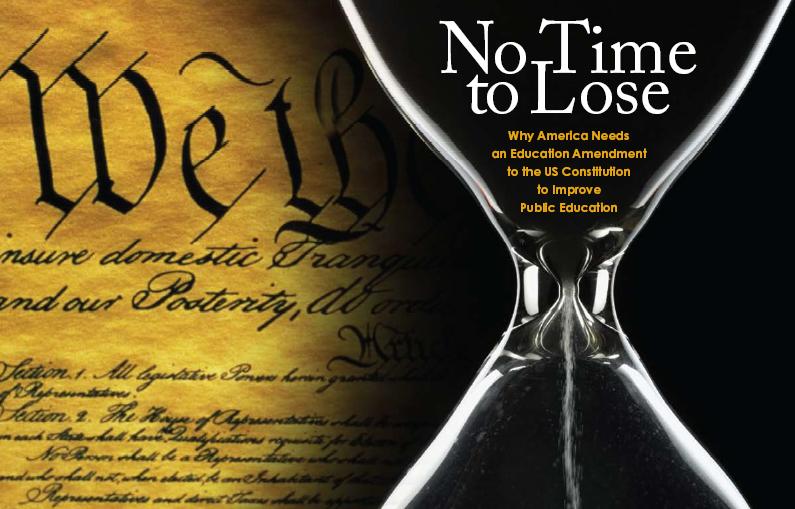
By Lynn Huntley, Esq., President, The Southern Education Foundation. This is the first of a two-part series on the organization's recent report called "No Time to Lose, Why America Needs an Education Amendment to the US Constitution to Improve Public Education." The report is available here.
I might have called this blog, "The Impossible Takes Longer," the name of a book of quotations of Nobel Prize Laureates. No, I do not have the presumption to place myself in such rarified company. I make the suggestion only because the subject of this blog and the recent report of the Southern Education Foundation called, "No Time to Lose, Why America Needs an Education Amendment to the US Constitution to Improve Public Education," may strike some as proposing the impossible.
I am not a polyanna. In the near term, I don't think that there will likely be an education amendment to the U.S. Constitution enacted. However, I also believe that race, place and class ought not to be good predictors of the quality of public education provided to students in a democracy dedicated to principles of fair play and that the status quo in this area is unacceptable and contrary to the national interest. Eventually the nation will have to come to terms with the problem of the inadequate and inequitable structures of public education opportunity allocation that negatively impact millions of low income students or win the "race to the bottom" in the competitive global economy.
I have no doubt that some day the U.S. Constitution will contain education-related provisions. Below I summarize some of the points set forth in SEF's report, "No Time to Lose," about why this should be the case.
The Problem
We all know that America faces a grave crisis in its many systems of public education. Each year, millions of Americans, most of them low income and members of vulnerable minority groups, are failing to achieve to high standards, dropping out of school in great numbers, and facing lives in poverty due to lack of skills with which to earn livable wages for themselves and their families. The stop gap and triage measures being advanced by philanthropy and well-intentioned educators are not making a real dent in this burgeoning problem. What we have is a lot of small scale, though worthy, efforts to help as many low income students as possible "slip through the net" by improving public education quality piecemeal.
America cannot keep wasting the productive capacities of its human capital each year and expect to prosper in the long haul. Inequality is trending upward. Each year more and more people fall into poverty. These low income, largely poorly educated people represent too much inchoate power and productive capacity to ignore. And because of population shifts, they will become ever more important parts of the nation's workforce in the future.
America is a developed nation. It cannot in a capitalist order compete with developing nations for manufacturing and other low end jobs that used to be an American staple. Labor is too cheap abroad for companies interested in profit maximization to provide such jobs in America. If America is to retain its fabled standard of living, it must find ways to increase the sophistication, skills and capacities of its people to attract "high end" jobs and innovate to grow the economy.
Thus the debate about how to improve public education for the mass of low income students whose interests it is failing to serve is vitally important. Our myopia disserves enlightened self-interest.
Sub rosa there are some who think that America only needs a small number of people to be highly educated and skilled. That static view of what the economy needs is outdated. Economies need lots of types of people with diverse perspectives and skills to function well in the global village. Investing in the education of people is investing in the "gift that keeps on giving."
All of my adult life, I have worked to help make access to the American Dream of fair treatment and upward mobility a reality for low income people, especially African Americans, who live at the margins of society. Having begun my education at age 6 in the proverbial one room school house in West Virginia, where Black students were segregated, I have always been keenly aware of just how unfair it is for public monies to be generously apportioned to provide some children with a much better quality public education and competitive "edge" than others. I grew up believing that was not what America was all about; that its great promise was to ensure equal treatment of residents and respect for the basic human rights of everyone, at home and abroad.
Most members of the middle class know that education is the ticket out of poverty and marginalization. That is why they fight so hard for quality public education for their sons and daughters and, if necessary, are willing to sacrifice to pay exorbitant private school fees.
Unfortunately, low income people may or may not understand the contemporary value of education. Even when they do, state and local officials more often than not place the children of the poor in largely inferior and often under-funded and under-resourced public schools. Those who need help the most, as a general rule, tend to receive the least as a matter of public policy and practice.
Large intrastate disparities in finance by school or school district contribute to the inability of public schools serving low income students to provide a quality opportunity to learn, often in contravention of state constitutional provisions related to education. That is the conclusion reached by dozens of state courts which have grappled with the need to remedy such disparities. Appendix A to "No Time to Lose" samples some of the pertinent judicial findings in public schools. Because of heavy reliance on local property taxes allocated by district to support schools and neighborhood or place-based disparities in wealth, some schools or districts have thousands of dollars more than others with which to educate students.
The problem of radical inequality and disparities in public education has an interstate dimension, as well. That is, wealth is not evenhandedly distributed across the states nor is poverty. Some states have lots of low income people as their tax bases and lower levels of tax productivity than others. They may expend more of their revenues proportionately on education than other states and still not have as much money to spend, differences in costs and standards notwithstanding.
States can't fix the interstate disparities problem alone. That is a uniquely federal problem calling for a federal remedy. Some won't be able to respond fulsomely to intrastate disparities either, unless they lower education expenditures for all students. No one these days thinks that standards and resources for public education should be reduced. The need is for more money and resources, not less. The aim is not to provide everyone with a mediocre education. The aim is to raise public education quality by ensuring ample resources and finance.
To be sure, money can't guarantee equality of learning outcomes. But money can guarantee that a fair opportunity to learn is provided to all, including those who live in low income districts. Money can guarantee essential resources that students need in order to learn and achieve to high standards.
A word about the social science associated with education improvements. So much of the testing regime to measure learning outcomes with which so many are preoccupied is based on a shallow model. A child may have had years of substandard education. Suddenly, he or she is placed in a quality school and may not excel.
Some are quick to seize upon such data to say that money doesn't matter. But remember: education is an iterative, a cumulative process. If a child doesn't get the basics early on, it may take years to make up for lost ground, if at all.
So what are we measuring when we take isolated snapshots of pieces of the puzzle without looking at how they fit together over the educational life of a child? How can we say that having quality schools for low income students doesn't make a difference when most have never had quality schools from the beginning through the end of their public education?
The elements that constitute the infrastructure of a quality opportunity to learn are apparent: good teachers, adequate facilities, quality instructional leadership, counseling services, security, libraries, text books, technology, aligned curriculum to high standards of achievement and expectation, after school services, quality pre-kindergarten, professional development and other learning essentials, among them.. Schools and school districts that lack money for such essentials short-change their students.
It should surprise no one if most students who receive an inferior education opportunity tend to score less well on standardized tests and other measures of proficiency than those who receive an excellent education. You can't learn what you are not taught. And if you come from an educationally or economically deprived background, you need extra help and inspiration to succeed in school.
The achievement gap, it turns out, is also a "resource and finance" gap. The frequent reports that one sees on America's failing public schools rarely focus on the disconnect between desired achievement ends and available resource and finance means with which to achieve desired achievement ends. We would rather "weigh the cow than consider how to ensure that it is well fed."
The federal role in relation to funding and resourcing of public education is unclear and variable. Partially funded mandates such as No Child Left Behind may set aspirational standards, but without funding that makes it possible for all states to defray compliance costs, such measures are just baby steps in the direction toward structural reform.
Does anyone seriously believe that the highly decentralized system of public education allocation that America has is the best, more efficient and cost effective way of ensuring that students, irrespective of station in life, are treated fairly? Isn't it tragic that although we have formal equal opportunity on the books but deny to low income and minority group students the opportunity to develop the ability to take advantage of equal opportunity through more and better education?
Why, on a matter of such importance, shouldn't the nation as a whole, through the highest law in the land, commit to ensure that every student has a fair chance for a good life through access to quality education? The U.S. Constitution is the embodiment of the nation's collective values and aims. It is our rosetta stone, mediating between and among individuals, groups, institutions, and governments.
Editor's Note: Visit ACSblog tomorrow for part II, "Making the Case for an Education Amendment."