



September 25, 2014
Private: The Case Against the Supreme Court
Erwin Chemerinsky, The Case Against the Supreme Court
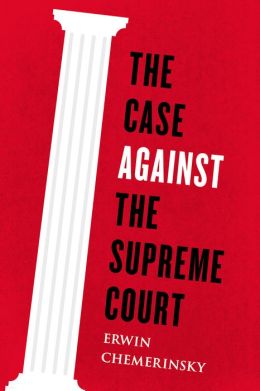
by Erwin Chemerinsky, Dean and Distinguished Professor of Law, Raymond Pryke Professor of First Amendment Law, University of California, Irvine School of Law
How should we assess the Supreme Court’s performance over the course of American history? That is the central question of my new book, The Case Against the Supreme Court. My conclusion is that the Supreme Court often has failed at its most important tasks and at the most important times. Recognizing this is important in order to focus on how to improve the institution and make it much more likely to succeed in the future.
Obviously the evaluation of any institution requires criteria by which it can be assessed. In the introductory chapter, I posit that the Court exists, above all, to enforce the Constitution. The Constitution exists to limit what government and thus the democratic process can do. As Marbury v. Madison said long ago, the limits contained in the Constitution are meaningless unless enforced and that is the “province and duty” of the courts. The judiciary is particularly important in protecting the rights of minorities (of all sorts) who cannot rely on, and should not have to rely on, the democratic majority. Also, the courts need to play a special role in times of crisis to ensure that society’s short-term passions do not cause it to lose sight of its long-term values.
I believe that all, liberal and conservative, can agree that these are fair criteria by which to assess the Supreme Court. I also think that liberals and conservatives can agree that the Court very often has failed. Part I of the book looks at the Court historically. Chapter one looks at the Court’s dismal record over the course of American history with regard to race. For the first 78 years of American history, from 1787 until 1865, the Court aggressively protected the rights of slave owners and upheld the institution of slavery. For 58 years, from 1896 until 1954, the Court approved and enforced the doctrine of “separate but equal.” The Court’s failure with regard to race continues to this day, as evidenced by the decision in Shelby County, Alabama v. Holder, which declared unconstitutional a key provision of the Voting Rights Act of 1965. This is the first time since the 19th century that the Court has invalidated a federal civil rights law to protect racial minorities.
Chapter two looks at the Court’s performance during times of crisis. Time and again, the Court has allowed the government to trample our most basic liberties and without any indication that it made the country safer. In World War I, the Court allowed individuals to be imprisoned for speech criticizing the draft and the war effort. In World War II, the Court upheld the evacuation of 110,000 Japanese-Americans from their lifelong homes, which led to their being placed in what President Franklin Roosevelt called concentration camps. During the McCarthy era, the Court permitted imprisoning individuals for even teaching about communism. Most recently, the Roberts Court said that federal criminal law could be used to punish those who helped foreign groups, designated as “terrorist,” learn how to use the United Nations to resolve their disputes peacefully or how to apply for humanitarian aid.
Chapter 3 looks at the Court and economic liberties and federalism. From the 1890s until 1937, a period of 40 years, the Court declared unconstitutional over 200 federal, state, and local laws that were designed to protect workers and consumers. For example, the first federal law to combat child labor was declared unconstitutional by the Court and countless children suffered enormously as a result.
As I have described in my thesis, I often am asked, what about the Warren Court? It certainly did a great deal to advance equality, expand liberties such as voting and privacy, and protect the rights of criminal defendants. Yet, some of its most praised decisions, such as for Brown v. Board of Education and Gideon v. Wainwright, did not do nearly enough. American public schools remain terribly separate and unequal. Many criminal defendants in the United States, including those facing possible death sentences, lack adequate representation.
Part II of the book looks at the Roberts Court. I recognize, of course, that my assessment here is more likely to be controversial and perceived as ideological. Chapter 5 looks at how the Roberts Court consistently protects business at the expense of employees and consumers and all of us. Chapter 6 examines a topic that does not receive nearly enough attention: the way in which the Roberts Court has closed the courthouse doors to those whose rights have been violated by the government. Finally, chapter 7 looks at the Roberts Court and the political process and especially its disastrous rulings with regard to campaign finance.
I, of course, am not contending that every Supreme Court decision has been wrong or even that most of them have been misguided. Nor do I agree with those who would eliminate judicial review. I have spent my career representing individuals – such as criminal defendants, the homeless, the politically unpopular, a Guantanamo detainee – for whom it is the courts or nothing.
But I believe that there are many reforms that can make the Court better and taken together make it less likely that it will so badly fail in the future. I propose a host of changes, including instituting merit selection of Supreme Court justices, creating a more meaningful confirmation process, establishing term limits for Supreme Court justices, changing the Court’s communications (such as by televising its proceedings), and applying ethics rules to the justices. At the very least, we must change how we talk about the Court and recognize that the justices are constantly making value choices based on their views and ideologies.
This was a very difficult book for me to write. I had to face that in my teaching and writing throughout my career that I have largely been making excuses for the Court and minimizing its failures. I wrote the book to ask us all to assess the Court and to consider how we can make it even better in the future.
Constitutional Interpretation, Democracy and Elections, Equality and Liberty, Supreme Court